Short answer: The TDS rate chart for tax year 2026-27 keeps the 1961 Act's rates and limits under new section numbers: salary is section 392, and most other payments to residents are serials of the Table in section 393(1). Contracts are 1% or 2%, professional fees and building rent 10%, technical services and machinery rent 2%, commission 2%, and goods 0.1% above ₹50 lakh.
A TDS rate chart for tax year 2026-27 (FY 2026-27) looks like last year's, because the rates and limits didn't change. The section numbers did: salary moved to section 392, most payments to residents moved to the serials of one Table in section 393(1), and challans and returns now carry new codes.
The chart is half the job. The other half is the yearly or quarterly applicability review: checking every party in the expense ledgers against it. This post follows a recent chart video, fixes its wrong rows, adds the review steps and an example, then explains how an AI agent would run the same review.
The tutorial this is based on
TDS Rate Chart Tax Year 2026-27 | TDS New Section Code list | TDS Rate Chart FY 2026-27 PDF Download by Tax guide nilesh, published 30 April 2026 (in Hindi). He walks his PDF chart row by row for payments to residents: the old section, the new section 393 reference, the return code, the threshold and the rate. Three rows need correcting. The chart puts all royalty at 2% under code 1026, but only royalty for films is 2% and other royalty is 10%; insurance commission is 2% except to a domestic company, which is 10%; and the contract rows show both rates in each column, where code 1023 is 1% and 1024 is 2%. We left out the salary codes he reads out, which we couldn't confirm, and since no recent video we found teaches the ledger review itself, steps 3 to 8 add it.
How do you use the TDS rate chart to review the expense ledgers?
- Start with the chart, as the tutorial does: for each payment, the new section and Table serial, the old section, the return code, the threshold and the rate (table below). Royalty for films is 2%; other royalty is 10%.
- Use the new references for anything credited or paid from 1 April 2026, whichever comes first. A bill credited on 31 March 2026 stays under the 1961 Act.
- Settle the payer's status from the preceding tax year's turnover. A specified person (rent, commission, professional fees, other interest) is anyone but an individual or HUF, or one with business turnover over ₹1 crore or professional receipts over ₹50 lakh. Contracts use a designated person, with the same test; goods need a buyer with turnover over ₹10 crore.
- Export the trial balance and each expense ledger's vouchers, so every bill shows its party.
- Give each party a chart row by what it supplies, not by the ledger's name, splitting mixed ledgers such as Repairs. Technical consultancy, for one, is a professional fee at 10%, not a technical service at 2%.
- Total each party the way its row is tested: by month for rent, by bill and by year for contracts, by year for fees and commission, by PAN for goods. Once a limit is crossed, TDS is due on the whole amount, earlier bills included, except for goods, where only the part above ₹50 lakh is taxed.
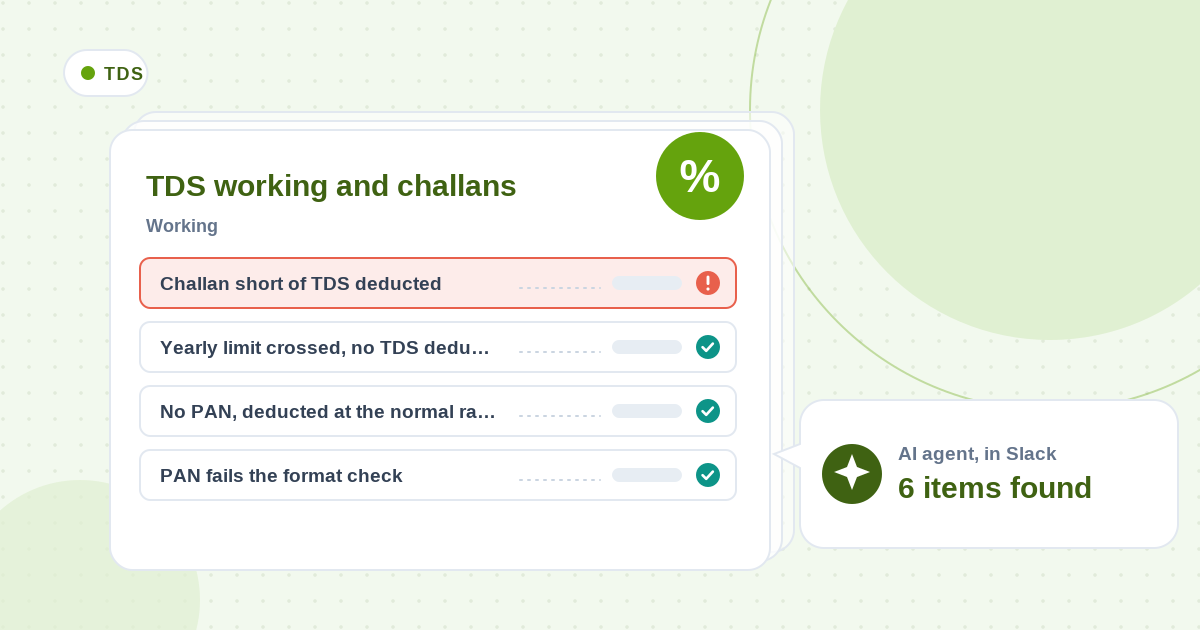
- Compare the TDS due with the TDS in each party's ledger, and check every PAN: without one the rate is at least 20%, or 5% for goods and e-commerce. The non-filer rate (206AB) went from 1 April 2025.
- Deduct each shortfall with interest at 1% a month or part of a month from when it was deductible, deposit by the 7th of the next month (30 April for March; Form 141 items within 30 days), and report it in Form 140 (it was 26Q) under the new code. The October to December return is due 31 January 2027.
TDS rate chart for tax year 2026-27: new section, old section, code, rate and threshold
| Payment | Section now | Old section | Return code | Rate | Threshold |
|---|---|---|---|---|---|
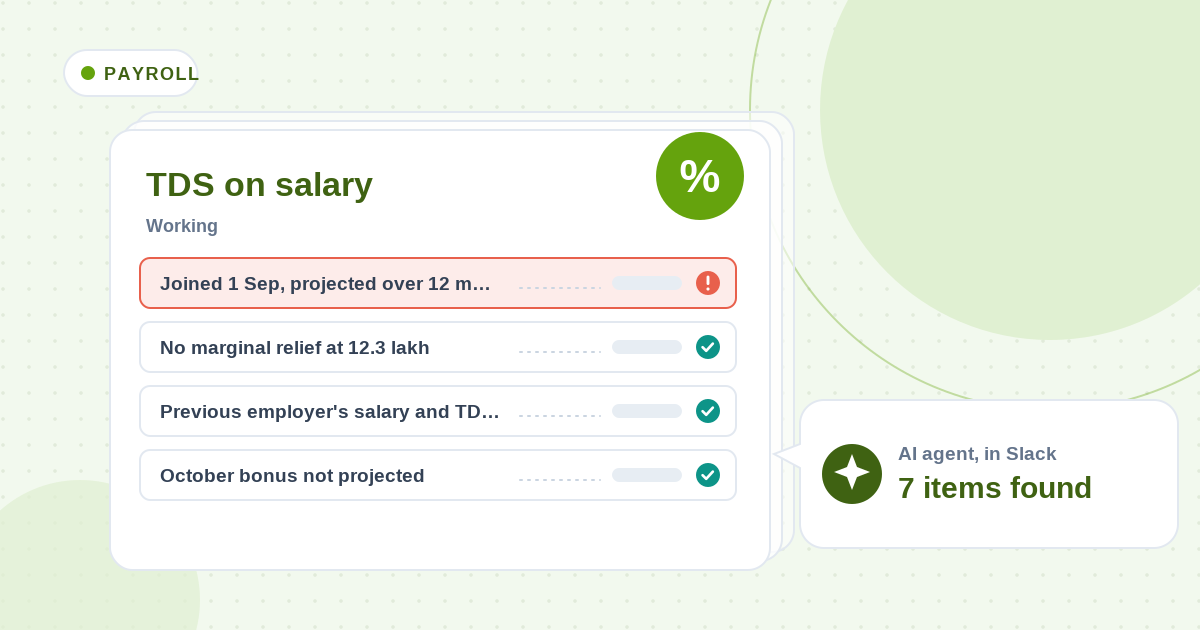
| Salary | 392(1) | 192 | Form 138 | Average rate on estimated salary | Worked on the year's estimate |
| Insurance commission | 393(1) Sl. 1(i) | 194D | 1005 | 2%; 10% to a domestic company | Above ₹20,000 a year |
| Commission or brokerage | 393(1) Sl. 1(ii) | 194H | 1006 | 2% | Above ₹20,000 a year |
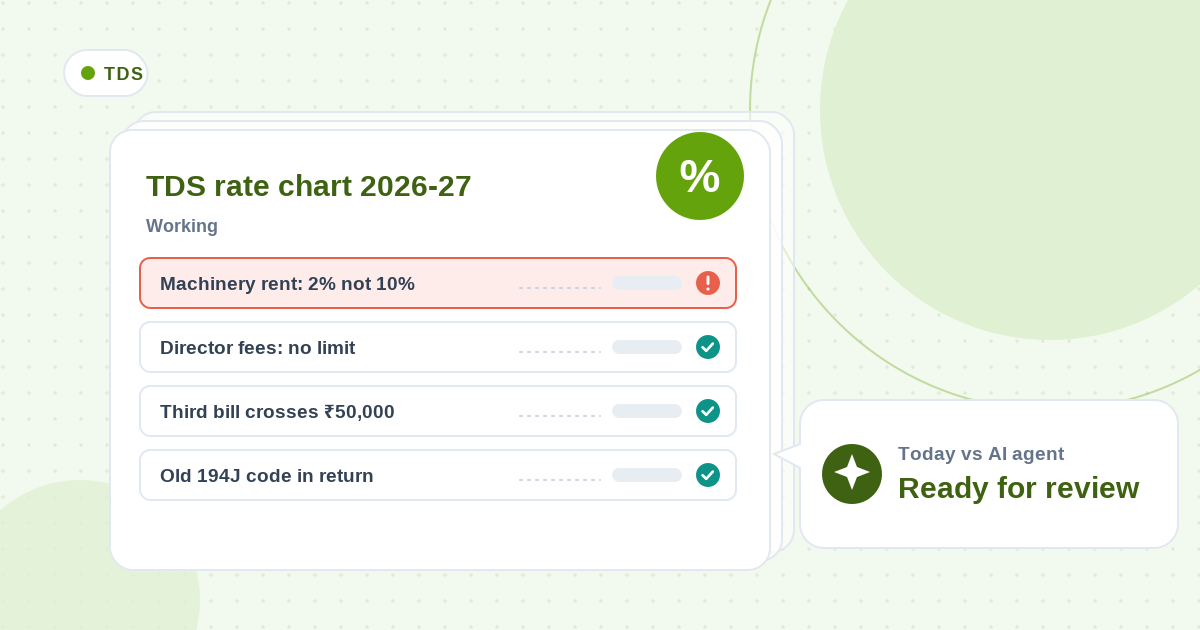
| Rent of plant, machinery or equipment | 393(1) Sl. 2(ii) | 194-I | 1008 | 2% | Above ₹50,000 for a month |
| Rent of land, building, furniture or fittings | 393(1) Sl. 2(ii) | 194-I | 1009 | 10% | Above ₹50,000 for a month |
| Rent paid by other individuals and HUFs | 393(1) Sl. 2(i) | 194-IB | Form 141 | 2% | Above ₹50,000 for a month |
| Purchase of immovable property | 393(1) Sl. 3(i) | 194-IA | Form 141 | 1% of price or stamp duty value, if higher | ₹50 lakh |
| Bank, co-operative bank or post office interest | 393(1) Sl. 5(ii) | 194A | 1020 senior citizen, 1021 others | 10% | Above ₹1,00,000 senior citizen, ₹50,000 others |
| Other interest, such as on loans | 393(1) Sl. 5(iii) | 194A | 1022 | 10% | Above ₹10,000 a year |
| Contract work, labour, manpower supply | 393(1) Sl. 6(i) | 194C | 1023 individual or HUF, 1024 others | 1% individual or HUF, 2% others | Above ₹30,000 a bill or ₹1,00,000 a year |
| Work, fees or commission paid by other individuals and HUFs | 393(1) Sl. 6(ii) | 194M | Form 141 | 2% | Above ₹50 lakh a year |
| Technical services, royalty for films, call centre | 393(1) Sl. 6(iii) | 194J | 1026 | 2% | Above ₹50,000 a year |
| Professional fees, non-compete sums | 393(1) Sl. 6(iii) | 194J | 1027 | 10% | Above ₹50,000 a year |
| Director's fees or commission, not salary | 393(1) Sl. 6(iii) | 194J | 1028 | 10% | None |
| Dividend | 393(1) Sl. 7 | 194 | 1029 | 10% | None; no TDS up to ₹10,000 to an individual, paid other than in cash |
| Purchase of goods (buyer's turnover over ₹10 crore) | 393(1) Sl. 8(ii) | 194Q | 1031 | 0.1% of the part above ₹50 lakh | Above ₹50 lakh from one seller a year |
| Business perquisite | 393(1) Sl. 8(iv) | 194R | 1033 / 1034 | 10% | Above ₹20,000 a year |
| Partner's salary, interest, commission or bonus | 393(3) Sl. 7 | 194T | 1067 | 10% | Above ₹20,000 a year |
A worked example: six months of expense ledgers
A made-up Coimbatore engineering company reviews April to September 2026. As a company it is a specified and a designated person, and every party has a PAN.
Three ledgers are short. The CA firm billed ₹20,000, ₹25,000 and ₹15,000; the third bill took the year to ₹60,000, so 10% is due on all of it (₹6,000), but only that bill was taxed: ₹4,500 short. Housekeeping at ₹40,000 a month, above ₹30,000 each bill, owed 2% of ₹2,40,000, or ₹4,800, and nothing was deducted. Two sitting fees of ₹15,000 to an independent director owed 10% from the first rupee: ₹3,000, also missed.
Two are over-deducted at 10%. Forklift hire, machine only, at ₹55,000 a month is plant at 2%: ₹6,600, not ₹33,000. IT helpdesk support of ₹1,20,000, treated as technical services, is 2%: ₹2,400, not ₹12,000. Office rent at 10%, and sales commission of ₹18,000, still under ₹20,000, are right.
So ₹12,300 is to be deducted now, with interest from when each bill's TDS was deductible. If housekeeping and the director's fees still have no TDS deducted and paid by the return due date, 30% of them, ₹81,000, can be disallowed under section 35(b) (it was 40(a)(ia)). The ₹36,000 over-deducted brings no disallowance, but the two vendors recover it as a tax credit in their own returns.
Where it usually goes wrong
- Machinery rent and technical services at 10%. Both are 2%.
- Testing an individual or HUF payer by tax audit, as several videos do. The Act uses the preceding year's turnover.
- A higher rate for payees who didn't file returns. That rule (206AB) went from 1 April 2025.
- Waiting for a threshold on director's fees. There is none.
- Testing contract bills one at a time. Small bills to one contractor carry TDS once the year's total passes ₹1,00,000.
- Quoting 194C or 194J for a 2026-27 payment, which the e-Filing FAQ says may need a correction statement.
- Reporting in Form 140 what belongs in Form 141, such as fees paid by an individual or HUF under Sl. 6(ii) (it was 194M).
How an AI agent does it
Each person on the team can have their own AI agent, used from Slack, WhatsApp or a web app. It reads the Tally exports you give it in Excel or XML and writes its working in Excel. It asks before it changes, posts, files or pays anything, and every step is logged. Below is how it would run the review on a client's expense ledgers; it can be wrong, so the last sections list what you still check.
What you give it
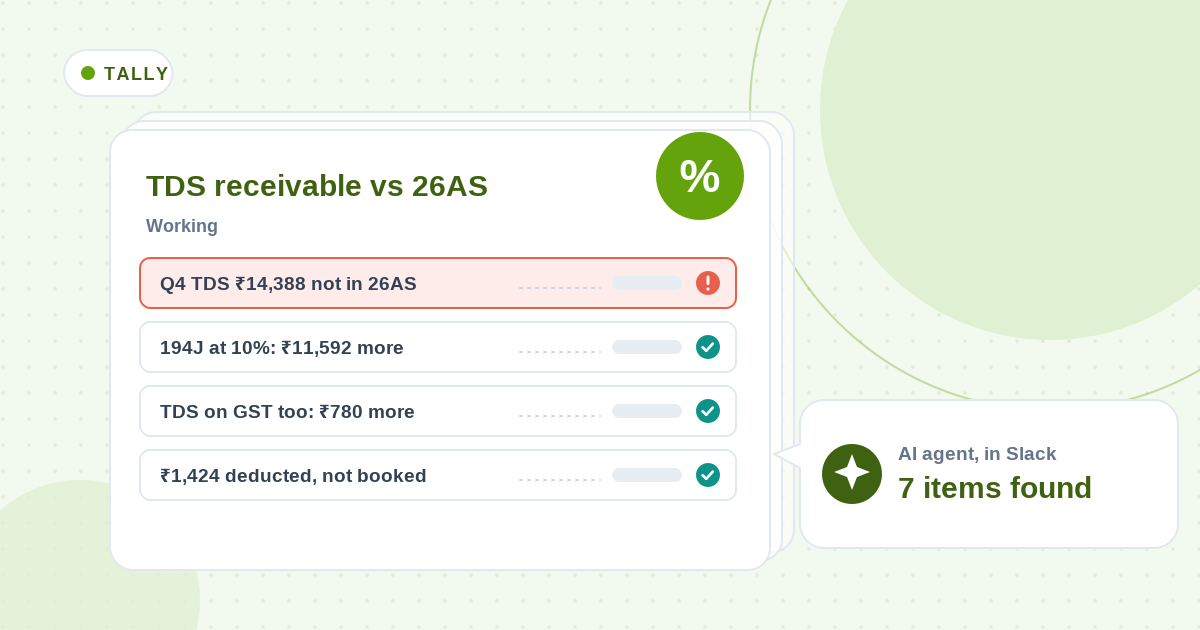
- The trial balance or group summary from TallyPrime, exported to Excel
- A ledger vouchers export for each expense ledger, or the Day Book for the period
- The party masters with PAN and deductee type, and TallyPrime's Ledgers without PAN report
- The TDS ledgers, the TDS Outstandings report and the preceding year's turnover
- For a quarter already filed, the Form 140 rows with each code and flag
What it does
- Maps every party in every expense ledger to a chart row by what it supplies, and notes its reason.
- Totals each party as its row is tested, works out the TDS due on the whole amount once a limit is crossed, and compares it with the party's ledger.
- Flags no TDS, short TDS after a crossing, wrong rates (10% on machinery rent or technical services, 1% against 2% by contractor type) and missing PANs.
- Flags credits to suspense or provision accounts, which count as credits to the payee, and untaxed transporters with no declaration on file.
- Checks challans and Form 140 rows for old sections such as 194C, and for amounts below a threshold that need flag Y.
- Works out each shortfall's interest period and the 30% disallowance at risk, keeps each party's row in the firm's shared memory, and can repeat the review each quarter on a schedule.
What it hands back
- A workbook with one row per ledger and party: chart row, code, amount booked, TDS due, TDS deducted and the difference
- A list of entries to correct, with the interest period for each shortfall
- Import-ready catch-up entries in Excel or XML, for your team to review and import into Tally
- A short list of classification questions, such as technical consultancy against technical services
What it leaves to you
- Decide a classification call. It shows its reasons; you choose the row.
- Judge a lower-deduction certificate or a transporter's declaration. It lists what is on file.
- Post the catch-up entries into Tally or pay the interest.
- File or correct the return.
Today vs with an AI agent
| Step | Today | With an AI agent |
|---|---|---|
| Gathering the inputs | You export the trial balance and ledger vouchers, and collect PANs and last year's turnover. | You give it the Tally exports, party masters and turnover once. It keeps them in shared memory. |
| The working | A sheet mapping each ledger to a section, ledger by ledger rather than party by party. | It maps every party to a chart row, with its reason, and totals each party as its row is tested. |
| The cross-checks | TDS in the larger ledgers checked against the rate. | It recomputes every party's TDS and compares it with the ledger. |
| Exceptions | Found when a vendor complains, or a default appears after processing. | It lists shortfalls, excess deductions, wrong rates, missing PANs and old codes. |
| The output | Catch-up entries in Tally and a note to the client. | A ledger-by-party workbook, a corrections list and import-ready entries. |
| The review | A senior checks the larger ledgers and the rates. | You check each party's row, the questions it raises and the payer's status. |
| Who signs off | The accountant decides the corrections; the client pays. | You decide the corrections, pay and file. It posts and pays nothing. |
What you still check
- Each party's row and code, above all in mixed ledgers.
- That every threshold crossing was taxed on the whole amount, earlier bills included.
- The payer's status for the year, from the turnover figure the agent was given.
- That no challan or return row uses an old section such as 194C.
- The classification questions it lists, and any lower-deduction certificate or transporter's declaration.
Questions accountants ask
Did TDS rates change for FY 2026-27 under the new Act?
No. The e-Filing FAQ says the 1961 Act's rates and thresholds were kept; only the sections and return codes changed.
What do TDS section codes 1023, 1024 and 1027 mean?
They are Form 140 codes: 1023 contract work by an individual or HUF, 1024 by others, 1026 technical services, 1027 professional fees, 1028 directors, 1031 goods, 1009 building rent, 1006 commission.
Can I still quote 194C or 194J in challans and returns?
Not for amounts credited or paid from 1 April 2026. The e-Filing FAQ warns the old section may cause processing errors and need a correction statement.
Is the higher TDS for non-filers (206AB) still there?
No, it was omitted from 1 April 2025. Only the no-PAN rule remains: at least 20%, or 5% for goods and e-commerce.
Is TDS on the whole bill or only the part above the threshold?
The whole amount once the threshold is crossed, earlier bills included, except purchase of goods, where only the part above ₹50 lakh is taxed.
Does the agent pass the entries or file the return?
No. It prepares the corrections and entries; you import them, pay and file.
Hand this job to an agent
Bring one of your own files to a 30-minute call and watch an agent do this job.
Book a 30-min demo