Short answer: TDS on professional fees is now section 393(1) Table Sl. 6(iii) (it was 194J). A specified person deducts 10% on professional fees, non-compete sums, other royalty and director's fees, and 2% on technical services, royalty for films and call-centre payees. The limit is ₹50,000 in the tax year, and director's fees have none. Once it is crossed, TDS is due on the whole amount.
Professional fees look simple: 10% once a vendor passes ₹50,000. The trouble is the rows beside them. Technical services are 2%, but technical consultancy is a professional service at 10%. Director's fees carry TDS from the first rupee. Placing ads is a contract, and from 1 April 2026 so is supplying staff who work under your supervision.
This post follows a recent tutorial on section 393(1) Table Sl. 6(iii) for tax year 2026-27 (FY 2026-27), adds GST, the return codes and the line with contracts, and works an example for one person paid three ways. Then it explains how an AI agent would sort the vendors and check the TDS.
The tutorial this is based on
TDS on Professional & Technical Fees | FY 2026-27 | Section 393(1) | Income-tax Act 2025 by CA Shweta Verma, published 16 October 2026 (in Hindi). She works through section 393(1) Table Sl. 6(iii) with examples: the turnover test for the payer, 2% against 10%, the ₹50,000 limit tested kind by kind, director's fees with no limit, the personal-payment exception, the fallback to Sl. 6(ii) (old 194M) and where advertising turns into a contract. We found no error in it. We added GST, the no-PAN rate, the return codes and the Finance Act 2026 change that moves manpower supply to Sl. 6(i). Her advertising examples include social and search platforms, some of which may bill from outside India, so check who bills you.
How do you work out TDS on professional fees and technical services?
- Check the payer. Sl. 6(iii) applies when a specified person pays a resident: anyone but an individual or HUF, or one whose business turnover was over ₹1 crore, or professional receipts over ₹50 lakh, in the preceding tax year. It is a turnover test, not an audit test.
- Sort each payment into its kind: professional fees, technical services, director's fees, royalty, or a non-compete sum (section 26(2)(h)). Section 402(28) lists the professions: legal, medical, engineering, architecture, accountancy, technical consultancy, interior decoration, advertising and any the Board notifies.
- Pick the rate. 2% is for technical services that aren't professional services, royalty for films and payees that only run a call centre (code 1026). The rest is 10%: professional fees and non-compete sums (1027), other royalty, and director's fees other than salary (1028), which have no limit.
- Draw the line with contracts. Work under Sl. 6(i) (it was 194C) includes advertising, broadcasting, carriage other than by rail, catering and manufacturing from the customer's material, at 1% or 2%. From 1 April 2026 it also covers supplying manpower to work under your supervision, control or direction (Finance Act 2026). On ads, the tutorial's rule: placing them is a contract; a model or photographer earns a professional fee.
- Test ₹50,000 per payee for the tax year; there is no single-bill limit. The tutorial tests each kind on its own, so a ₹45,000 technical fee to someone paid ₹60,000 of professional fees carries no TDS. The e-Filing FAQ says the 1961 Act's limits were kept, and that Act gave each kind its own, but the new table prints one ₹50,000 for all four kinds: check before relying on the per-kind reading.
- When the total passes ₹50,000, deduct on the whole amount, taking the earlier bills' TDS from the crossing bill. The tutorial's lawyer is paid ₹15,000, then ₹45,000: 10% of ₹60,000, ₹6,000, all from the second bill. Goods work the other way.
- Work on the fee without GST when the bill or contract shows GST separately (CBDT Circular 23/2017, carried over by section 536(2)(j) so far as it fits the new Act). Without a PAN, deduct 20%.
- Deduct at credit or payment, whichever is earlier, so advances too. Deposit by the 7th of the next month (30 April for March) and report in Form 140 under code 1026, 1027 or 1028; the October to December return is due 31 January 2027.
- An individual or HUF deducts nothing on fees paid only for personal purposes, such as their own doctor's fee. One that isn't a specified person deducts 2% under Sl. 6(ii) (it was 194M) once payments for work, fees or commission pass ₹50 lakh in the year, through Form 141 with no TAN.
TDS on professional fees (194J) and the rows beside it: codes, rates and limits for 2026-27
| Payment | Item now (old) | Code | Rate | Limit in the tax year |
|---|---|---|---|---|
| Professional fees: CA, lawyer, doctor, architect, engineer, technical consultancy, interior decorator, a model or photographer for an ad | 6(iii), rate (b) (194J) | 1027 | 10% | Above ₹50,000 |
| Fees for technical services that are not professional services | 6(iii), rate (a) (194J) | 1026 | 2% | Above ₹50,000 |
| Royalty for films; a payee that only runs a call centre | 6(iii), rate (a) (194J) | 1026 | 2% | Above ₹50,000 |
| Other royalty | 6(iii), rate (b) (194J) | Check in the utility | 10% | Above ₹50,000 |
| Non-compete sum under section 26(2)(h) | 6(iii), rate (b) (194J) | 1027 | 10% | Above ₹50,000 |
| Director's fees or commission, not salary | 6(iii)(c) (194J) | 1028 | 10% | None |
| Contract work, ad placement, manpower supply | 6(i) (194C) | 1023 / 1024 | 1% individual or HUF, 2% others | Above ₹30,000 a bill or ₹1,00,000 a year |
| Paid by an individual or HUF not covered above | 6(ii) (194M) | Form 141 | 2% | Above ₹50 lakh |
A worked example: one person paid three ways
A made-up Hyderabad software company pays one person in tax year 2026-27, a resident CA who is also its non-executive director. Professional bills show GST at 18% separately. A ₹30,000 professional fee plus ₹5,400 GST on 12 May carries no TDS yet; a ₹20,000 sitting fee on 30 June carries 10% with no limit: ₹2,000.
A ₹45,000 technical fee on 5 August, tested on its own as the tutorial does, is under ₹50,000 and carries no TDS; counted with the professional fees it would make ₹75,000, past the limit, which is the reading to confirm. On 18 September a ₹35,000 professional bill plus ₹6,300 GST takes professional fees to ₹65,000, so 10% of the whole ₹65,000, ₹6,500, comes off this bill. The payment is ₹35,000 plus ₹6,300 less ₹6,500: ₹34,800. Without GST shown separately, the TDS would be ₹7,670.
In a second case, a made-up ad agency, a company, bills ₹80,000 for placing newspaper ads: work under Sl. 6(i) at 2%, so ₹1,600. Booked as a professional fee at 10% it would be ₹8,000, and the agency would be paid ₹6,400 short.
Where it usually goes wrong
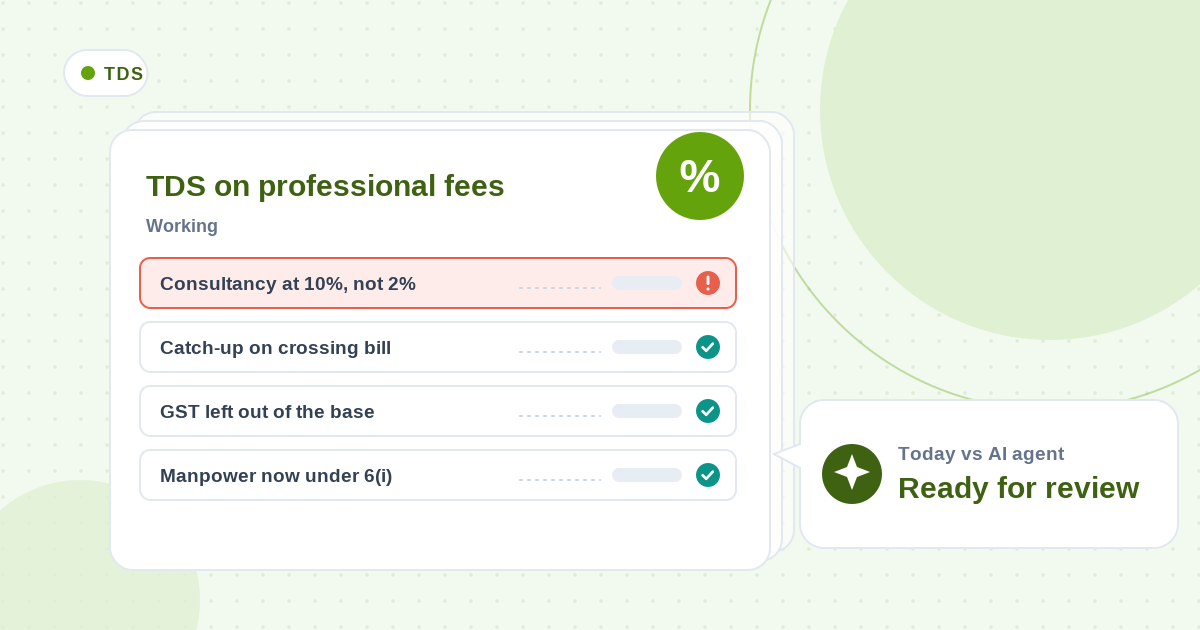
- Technical consultancy at 2%. It is a professional service, so 10%.
- Taxing only the bill that crosses ₹50,000. The earlier bills' TDS is due too.
- Waiting for ₹50,000 on director's fees. There is no limit, and flag Y can't be used for code 1028.
- Testing an individual or HUF payer by tax audit instead of the preceding year's turnover.
- Treating every advertising bill as a professional fee. Placing ads is a contract. Platform ads may be billed from outside India, and this item covers only residents, so check who bills you.
- Keeping manpower supply under 194J after 1 April 2026. It is now a contract under Sl. 6(i).
- Leaving a fee untaxed. Besides interest, 30% of it can be disallowed under section 35(b) (it was 40(a)(ia)) unless the TDS is deducted and paid by the return due date: in the e-Filing FAQ's example, ₹5 lakh of fees means a ₹1.5 lakh disallowance.
How an AI agent does it
Everyone on the team can have an AI agent of their own, reached from Slack, WhatsApp or a web app, with its own files, spreadsheets and a real web browser. It reads the ledger exports and PDF invoices you give it, writes its working in Excel, and asks before it changes, posts, files or pays anything, logging every step. Here is how it would sort professional and technical fees and check the TDS. It makes mistakes too, so the sections after this one say what a person checks.
What you give it
- Ledger vouchers exports from TallyPrime in Excel for the fee ledgers: Legal and professional, Consultancy, IT support, Advertising, Manpower, Director sitting fees and Royalty
- The vendor masters with PAN, deductee type and the nature of payment set in Tally
- The invoices or bill descriptions as PDFs, so it can see what was supplied and whether GST is shown separately
- The TDS ledgers, and for a quarter already filed, the Form 140 rows with code and flag
What it does
- Classifies each vendor, and each bill where a vendor supplies mixed things: professional (10%, technical consultancy included), technical services (2%), royalty for films or call centre (2%), other royalty or non-compete (10%), director (10%), contract or manpower (1% or 2%), or outside the item because the payee isn't resident.
- Notes the reason for each, from the invoice description.
- Totals each payee's fees for the year, kind by kind and in all, and finds the crossing bill on the reading your firm follows.
- Recomputes TDS on the fee without GST where GST is shown separately, and compares it with the TDS booked, bill by bill.
- Flags wrong rates, missing catch-ups, director's fees without TDS, payees without a PAN at 20%, and old 194J references.
- Prepares catch-up entries as import-ready Excel or XML for your team, and keeps each vendor's classification in the firm's shared memory.
What it hands back
- A vendor classification table: kind, code, rate and the reason for each
- A bill-wise TDS check: due, booked and the difference, with the crossing bill marked
- A short list of borderline vendors, each with the question to decide
- Draft catch-up entries, ready for your team to import into Tally
What it leaves to you
- Decide a borderline classification: IT services as technical services, technical consultancy or a contract; software as royalty or not; event management; outsourced payroll.
- Accept or judge a payee's lower-deduction certificate.
- Pass the corrections, pay the interest or file the return.
Today vs with an AI agent
| Step | Today | With an AI agent |
|---|---|---|
| Gathering the inputs | You export the fee ledgers and open bills to see what each vendor supplied. | You give it the ledger exports, vendor masters and invoices. It reads what each bill was for. |
| The working | A vendor list with a section and rate for each, often carried over from last year. | It classifies each vendor and mixed bill, totals by payee and finds the crossing bill. |
| The cross-checks | TDS booked against the rate for the larger vendors. | It recomputes every bill on the fee without GST and compares it with the TDS booked. |
| Exceptions | Found when a vendor queries a deduction or a short deduction shows up after the return. | It lists wrong rates, missing catch-ups, untaxed director's fees, missing PANs and old references. |
| The output | Corrected entries and an updated vendor list. | A classification table, a bill-wise check, a borderline list and draft entries. |
| The review | A senior checks the rates for new vendors. | You decide the borderline vendors and check directors, manpower contractors and the ₹50,000 test. |
| Who signs off | The accountant decides the rates; the client pays. | You decide the classifications, pay and file. It posts and pays nothing. |
What you still check
- That technical consultancy vendors are at 10%, not 2%.
- That manpower and housekeeping contractors sit under Sl. 6(i) for amounts from 1 April 2026.
- That director's fees are taxed from the first rupee.
- Any payee paid for more than one kind, and which reading of the ₹50,000 your firm follows.
- The GST base, and codes 1026, 1027 and 1028 in the return.
Questions accountants ask
What is the new section for 194J?
Section 393(1), Table serial 6(iii), of the Income-tax Act 2025, with Form 140 codes 1026 (the 2% items), 1027 (professional fees and non-compete sums) and 1028 (directors).
What is the TDS rate on professional fees and technical services?
10% on professional fees, other royalty, non-compete sums and director's fees; 2% on technical services that aren't professional services, royalty for films and call-centre payees; 20% without a PAN.
What is the TDS on professional fees limit for FY 2026-27?
₹50,000 in the tax year per payee, with no single-bill limit (it was ₹30,000 before 1 April 2025). Director's fees have none. Once crossed, TDS is due on the whole amount.
Do individuals have to deduct TDS on professional fees?
Only if their business turnover was over ₹1 crore, or professional receipts over ₹50 lakh, in the preceding tax year, and not on personal payments. Others deduct 2% under Sl. 6(ii) once payments for work, fees or commission pass ₹50 lakh in the year, through Form 141.
Is TDS on professional fees deducted on the GST?
No, if the bill or contract shows GST separately (CBDT Circular 23/2017). If not, TDS is on the whole amount.
Does the agent decide whether a fee is professional or technical?
No. It gives a reason for each vendor and lists the borderline ones for you to decide. It doesn't post, pay or file.
Hand this job to an agent
Bring one of your own files to a 30-minute call and watch an agent do this job.
Book a 30-min demo