Short answer: Put the TDS receivable from Tally next to Form 26AS, customer by customer, and explain every difference: credits missing from 26AS, TDS you never booked, the wrong section or base, and bills that fall in next year's statement. Claim only entries with status F. Income in 26AS that isn't in your books needs an answer before you file. For FY 2025-26 the statement is still Form 26AS; from tax year 2026-27 it is Form 168.
The TDS receivable ledger and Form 26AS should agree, but at year end they rarely do. Each difference has its own fix: some need a journal, some need an email to the customer, and some only need to wait for next year's statement.
Here is the method from a recent tutorial, then an agent matching a year of TDS for a facility services company with nine customers. It found most of the gaps in its first reply and the rest when asked.
The tutorial this is based on
26AS Reconciliation Process Simple Steps by practical Base Accounting, published 18 September 2026 (in Hindi). Shows where to find 26AS, how to book TDS in Tally and how to match it by party. It works through a single sale, with the 26AS rows typed in by hand, and its example deducts 10%; the right rate depends on the section, so check each customer's. The matching is described rather than shown, so we added the steps.
How do you reconcile 26AS with the books?
- Download Form 26AS for the year: on the e-filing portal, e-File > Income Tax Returns > View Form 26AS, then export it.
- Export the TDS receivable from Tally: customer, invoice number and date, taxable value, GST, section and the TDS you booked. The video books TDS with a journal: Dr TDS Receivable, Cr the customer.
- Total both by customer (or by TAN), with the amount and the TDS, and put the difference next to each.
- For each customer with a difference, go down to the invoice: which entry is missing on which side, and which has a different amount.
- Give each difference a reason: the customer hasn't filed, you didn't book the TDS, a different section or rate, TDS on the value with GST, a bill that falls in next year's statement, or income in 26AS that isn't in your books. The video's rule: your books may show more income than 26AS, never less.
- Check the status of booking. Only F (final) entries give credit; U (unmatched), P (provisional) and O (overbooked) need the deductor to act.
- Walk from the books total to the 26AS total until the difference is zero. Then pass journals for what is yours to fix and write to customers about the rest.
Where it usually goes wrong
- Taking credit for an entry with status U.
- TDS a customer deducted left out of the books, so its ledger shows money still due.
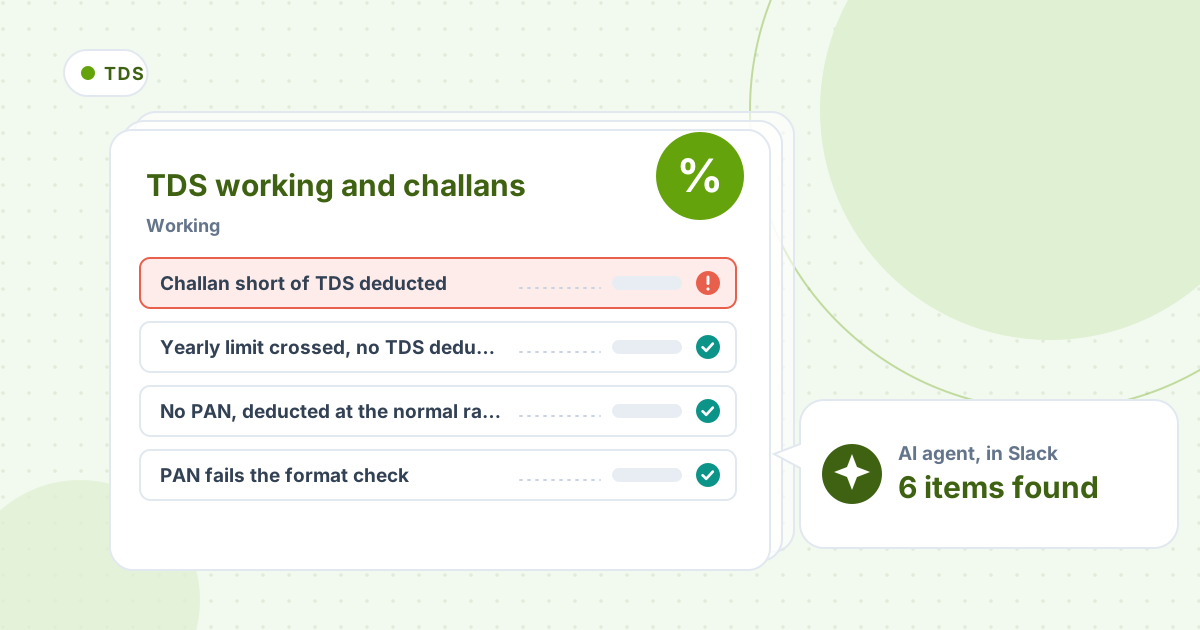
- A customer deducting on the value with GST, or under 194J at 10% for work that is 194C at 2%, and nobody noticing.
- Chasing a customer for a 31 March bill that will show in next year's statement.
- Income in 26AS that isn't in your books, left unexplained.
How an AI agent does it from Slack
We gave the agent two files for a made-up facility services company, Sarthi Facility Services, with nine customers: the TDS receivable working from Tally for FY 2025-26 (92 invoices) and Form 26AS (89 entries). Every company, name, tax number and amount in these files is made up. The agent works in Slack, where it shows up as Mnemio AI, because Accountant AI is built on Mnemio AI.
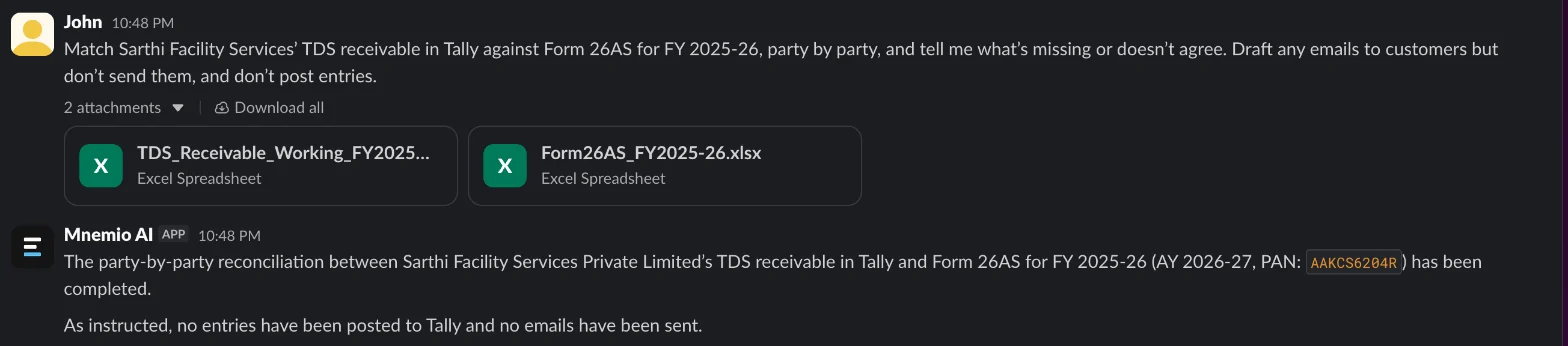
What the agent did
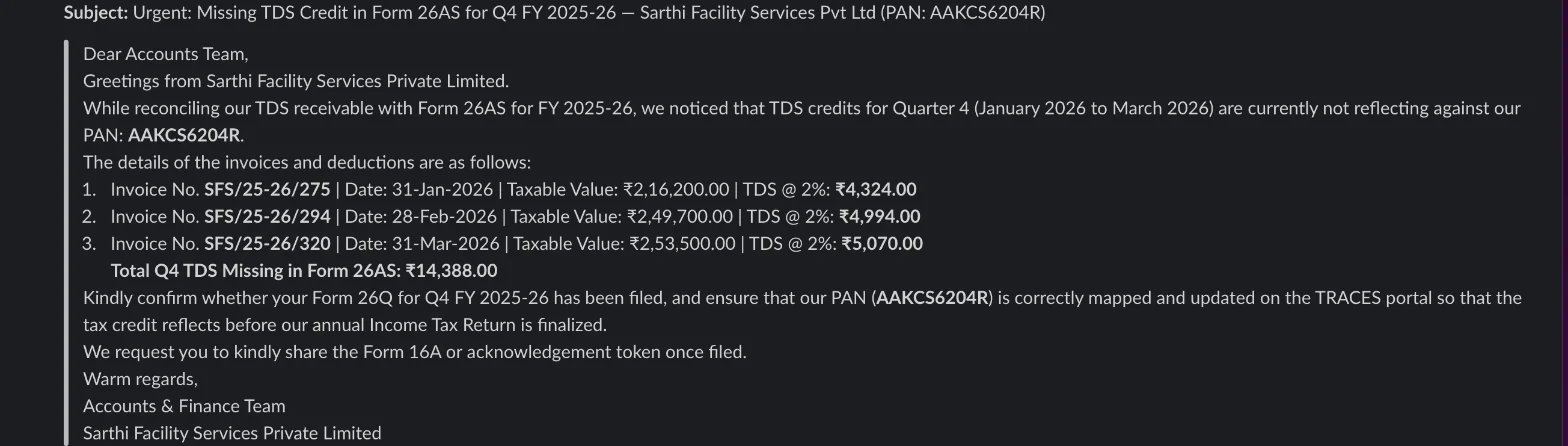
- Matched 92 invoices in the books against 89 entries in 26AS by customer, wrote a workbook and five email drafts, and posted and sent nothing.
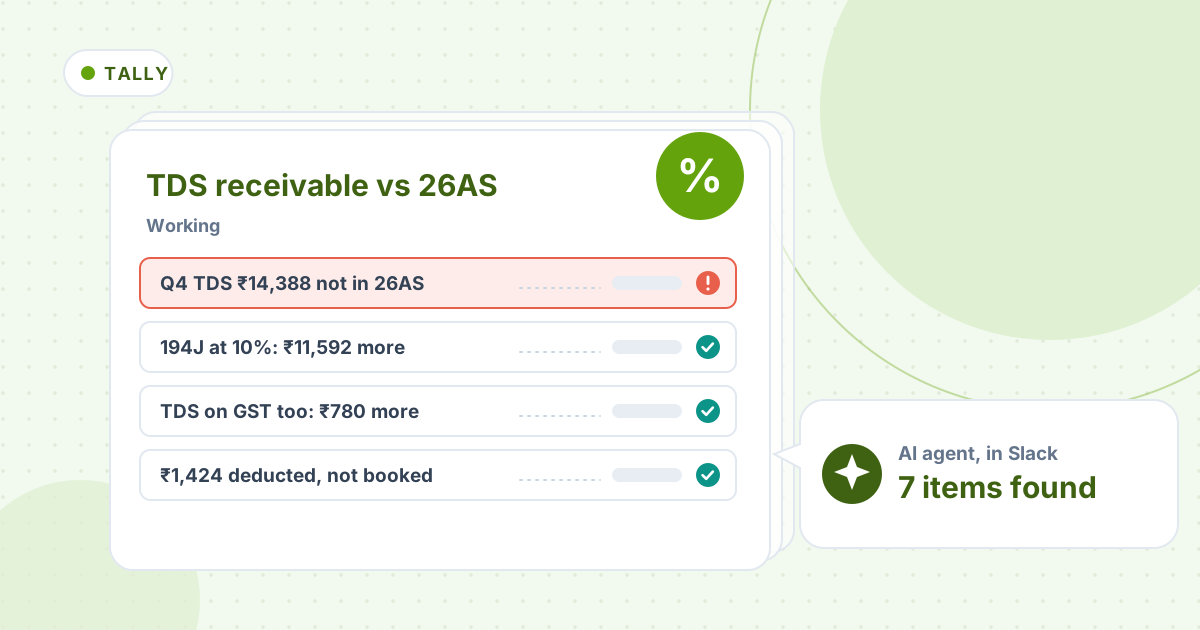
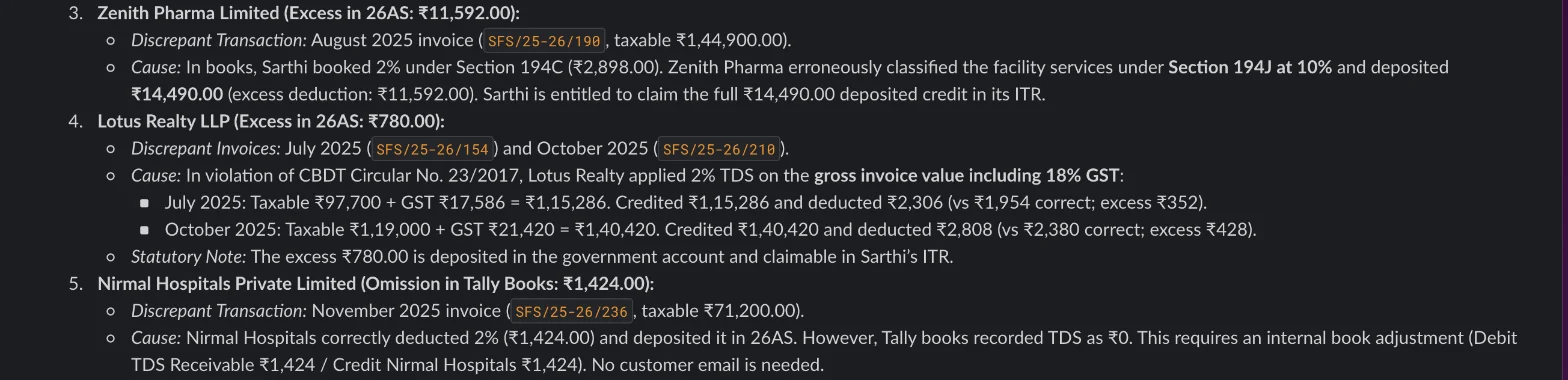
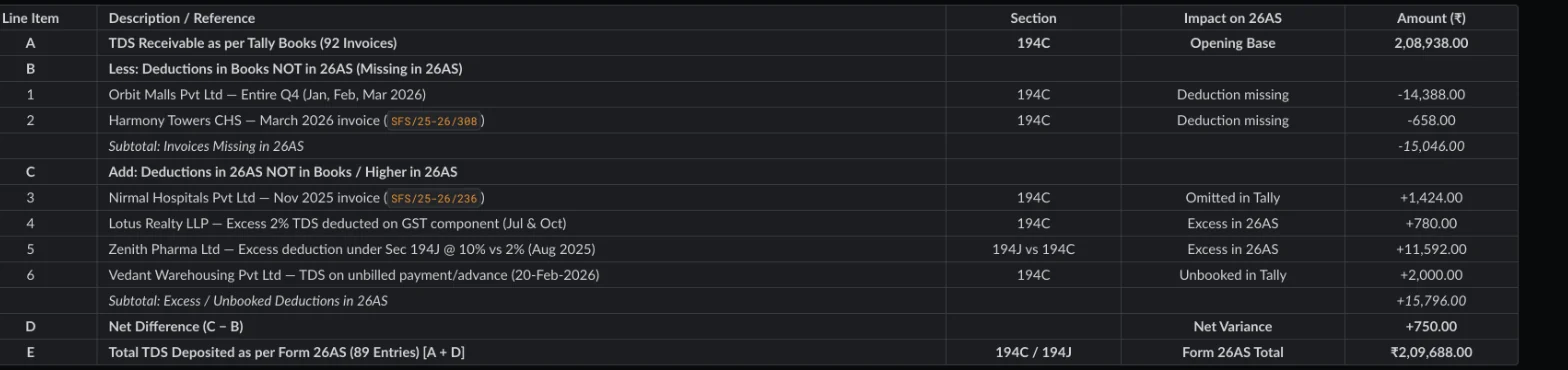
- Found Orbit Malls' Q4 missing from 26AS (₹14,388), Zenith's 194J deduction (₹11,592 more), Lotus deducting on the value with GST (₹780 more), Nirmal's TDS not booked (₹1,424) and ₹1,00,000 of income from Vedant with no invoice.
- Missed the status-U entry, showing Prime Auto as fully matched, and asked Harmony Towers to correct its return for a 31 March bill. It treated Vedant's ₹1,00,000 as an advance rather than asking whether a bill should be raised.
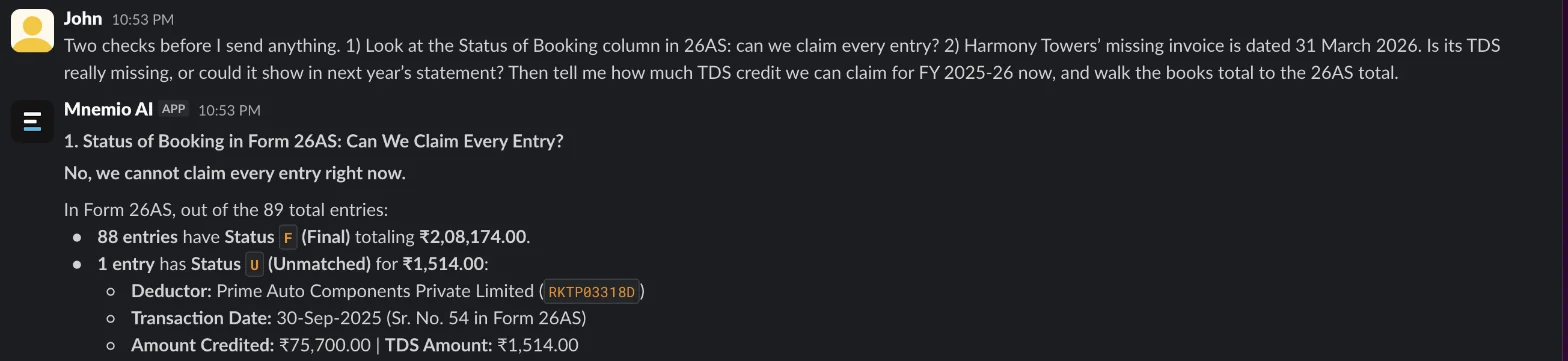
- When asked about the status column and the 31 March bill, it found the U entry (₹1,514), said ₹2,08,174 can be claimed now, said Harmony's bill is likely in next year's statement, and walked ₹2,08,938 to ₹2,09,688.
- It also said to claim Harmony's ₹658 next year. When asked again, it agreed the credit belongs to FY 2025-26 but pointed to section 155(14); the route for TDS deducted a year after the income was taxed is section 155(20), with Form 71 (Form 102 from 2026).
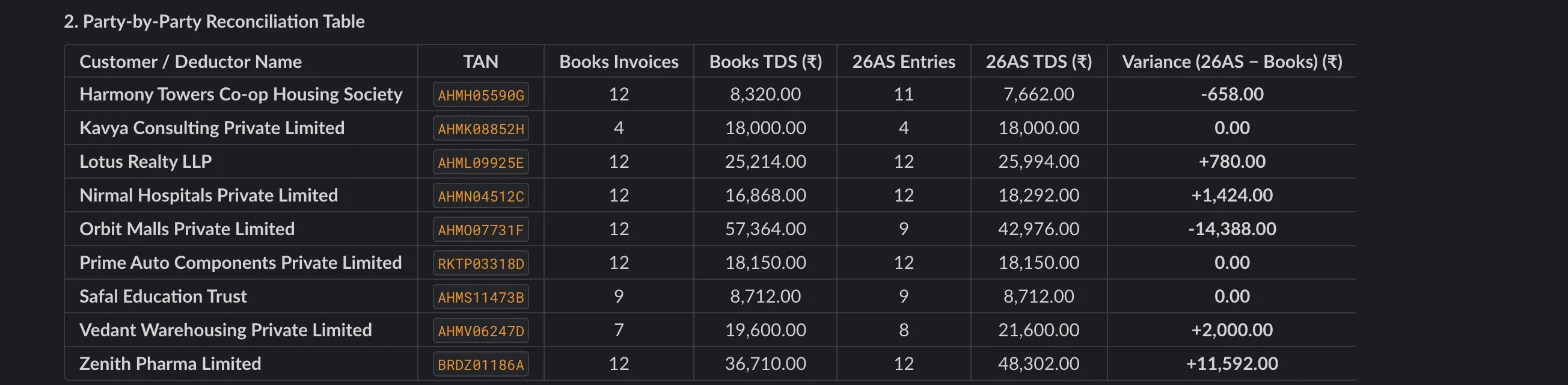
What it found
| Customer | Difference | What to do |
|---|---|---|
| Orbit Malls | Q4 TDS ₹14,388 not in 26AS | Ask them to file Q4 with your PAN |
| Zenith Pharma | 194J at 10%: ₹11,592 more | Book the extra TDS; tell them |
| Lotus Realty | TDS on GST too: ₹780 more | Book it; ask them to use the taxable value |
| Nirmal Hospitals | ₹1,424 deducted, not booked | Dr TDS Receivable, Cr Nirmal |
| Vedant Warehousing | ₹1,00,000 income, no invoice | Ask; if it's yours, invoice it with GST |
| Prime Auto | ₹1,514 with status U | Ask them to correct the challan |
| Harmony Towers | 31 March bill, ₹658 | Likely in next year's statement |

What you still check
- Where each email goes. The agent made up the customers' email addresses; take them from your customer master.
- Vedant's ₹1,00,000. The agent treated it as an advance. If the work was done, raise the invoice with GST, and claim its ₹2,000 only once the income is in your books.
- Which year Harmony's ₹658 goes in. The credit belongs to FY 2025-26, the year the income is taxed. If it shows in next year's statement, the route is section 155(20) with Form 71 (Form 102 from 2026), within two years from the end of the year the tax was deducted. The agent first said to claim it next year, then cited the wrong section.
- The status of every entry when you file. Claim only F entries; the agent missed the U entry until asked.
Questions accountants ask
Why doesn't my TDS receivable match 26AS?
Usually for one of a few reasons: a customer hasn't filed its TDS return or quoted the wrong PAN, you haven't booked TDS a customer deducted, the customer used a different section or rate or deducted on the value with GST, or the TDS falls in a different year. Match customer by customer and the reasons show up.
Can I claim TDS that has status U in 26AS?
No. U means the deductor's statement doesn't match its challan. Ask the deductor to correct it; the credit is given once the entry turns F.
Is it still called Form 26AS?
For FY 2025-26, yes. From tax year 2026-27, under the Income-tax Act 2025, the annual tax statement is Form 168.
Hand this job to an agent
Bring one of your own files to a 30-minute call and watch an agent do it.
Book a 30-min demo