Short answer: Project each employee's taxable salary for the year, work out the tax on the new regime slabs with the 12 lakh rebate, marginal relief and 4% cess, take off the TDS already deducted, and divide the rest by the months left. Re-project after joiners, bonuses and pay changes. An AI agent can check every employee against HR's sheet, but check how your payroll treats employer NPS.
Monthly TDS on salary is an estimate that has to be redone every time something changes: a joiner, a bonus, a declaration. Most errors come from a projection nobody updated.
Here is the method from a recent tutorial, then an agent checking HR's November projection for a 30-person software company, the mistake it made on employer NPS, and the two follow-ups it needed.
The tutorial this is based on
Salary Par TDS Kaise Calculate Hota Hai? | TDS on Salary Calculation 2026-27 by The Accounts, published 18 September 2026 (in Hindi). A teacher and a student work one made-up employee in Excel, from monthly pay to the March true-up. The video names no section and skips the rebate and marginal relief; we added them. TDS on salary is section 392 of the Income-tax Act 2025 (it was section 192).
How do you calculate TDS on salary each month?
- Find each employee's regime. If they declared nothing, the new regime applies.
- Project the year's salary: what was paid so far, plus this month's pay times the months left. A mid-year joiner counts only the months with you. Add a previous employer's salary and TDS from Form 122 (it was Form 12B).
- Add the employer's NPS contribution to salary if your payroll pays it on top of gross, then deduct it up to 14% of basic plus DA. Anything above 14% stays taxable.
- Take off the 75,000 standard deduction. Under the new regime, professional tax and 80C investments don't count.
- Work out the tax on the new regime slabs: nil up to 4 lakh, then 5%, 10%, 15%, 20% and 25% on each 4 lakh band, and 30% above 24 lakh.
- Apply the rebate: no tax when taxable income is up to 12 lakh. Just above it, marginal relief caps the tax at the income above 12 lakh. Add 4% cess.
- Monthly TDS is the year's tax, less TDS already deducted here and by a previous employer, divided by the months left. Re-project after any bonus or pay change, and pay by the 7th of the next month.
Where it usually goes wrong
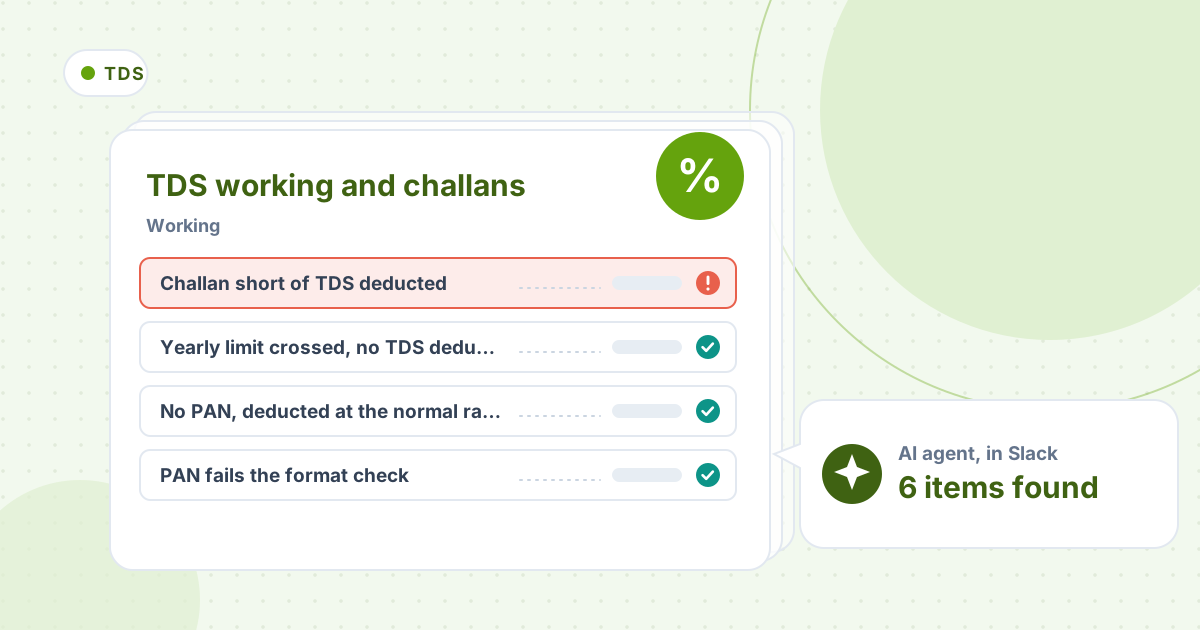
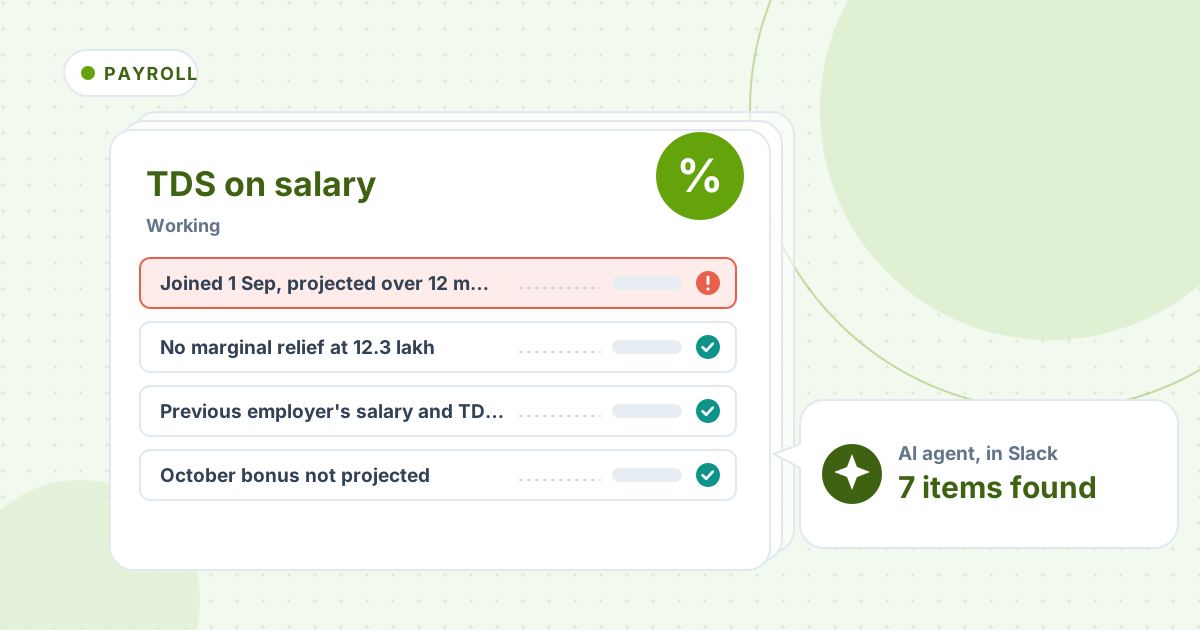
- A mid-year joiner projected over 12 months.
- A bonus paid without re-projecting, which leaves a big catch-up for March.
- A previous employer's salary and TDS left out, so the employee looks under the 12 lakh rebate.
- No marginal relief for someone just over 12 lakh.
- Employer NPS above 14% of basic deducted in full.
- Professional tax deducted under the new regime.
- Taking employer NPS off a gross that never included it. The agent did this.
How an AI agent does it from Slack
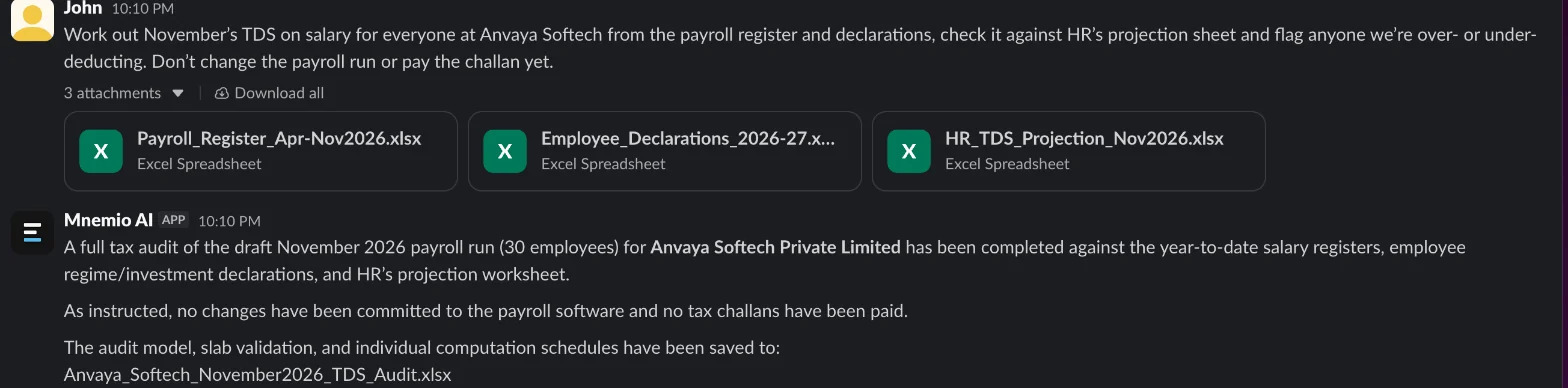
We gave the agent three files for a made-up Pune software company, Anvaya Softech, with 30 employees: the salary register for April to November 2026 (November is the draft run), the employees' regime and investment declarations, and HR's TDS projection for November. Every company, name, tax number and amount in these files is made up. The agent works in Slack, where it shows up as Mnemio AI, because Accountant AI is built on Mnemio AI.
What the agent did
- Checked each employee's projection against the salary register and declarations, saved the working as a workbook, and changed nothing in the payroll run.
- Found four of the six problems: a September joiner projected over 12 months, a previous employer's salary and TDS left out, an October bonus not projected, and professional tax deducted under the new regime.
- Got employer NPS wrong. It said HR had forgotten to deduct it for seven people and cut their TDS, but the register pays NPS on top of gross, so HR's figure already nets it off. It also missed marginal relief for an employee just over 12 lakh. Its total was ₹4,10,880.
- Asked whether NPS is inside gross pay, and about the employee just over 12 lakh, it withdrew the NPS claim and applied marginal relief (tax ₹31,200, November ₹277). But it dropped the one employee whose NPS is above 14% of basic.
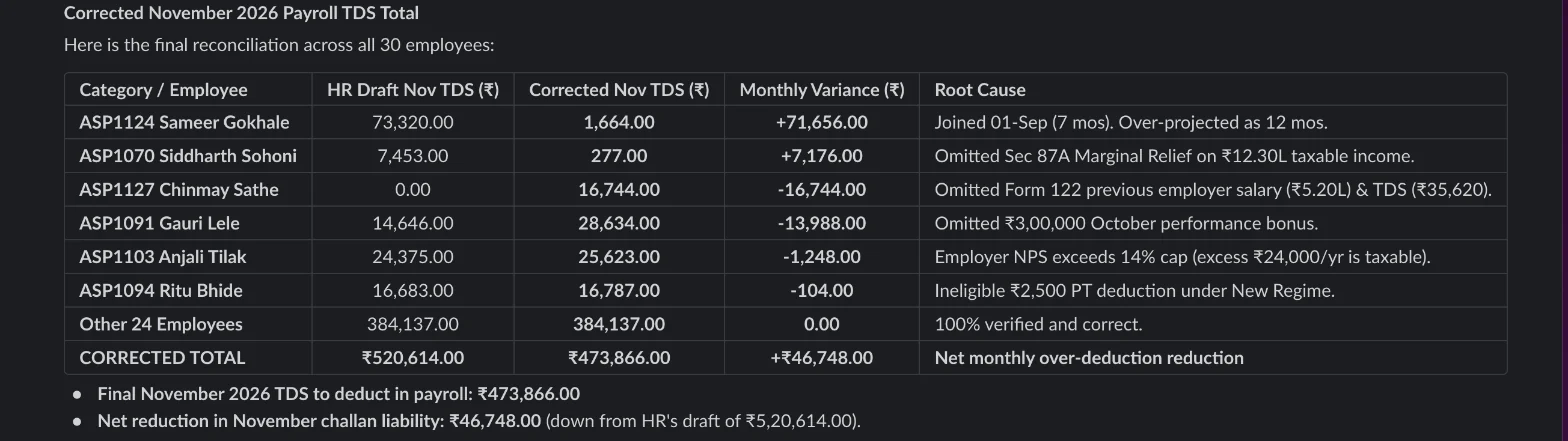
- Reminded of its own first-reply point about her 16% NPS, it taxed the excess ₹24,000 and put November's TDS at ₹4,73,866, against HR's ₹5,20,614.

What it found
| Employee | Problem | HR draft (₹) | Corrected (₹) |
|---|---|---|---|
| Sameer Gokhale | Joined 1 Sep, projected over 12 months | 73,320 | 1,664 |
| Siddharth Sohoni | No marginal relief at 12.3 lakh | 7,453 | 277 |
| Chinmay Sathe | Previous employer's salary and TDS left out | 0 | 16,744 |
| Gauri Lele | October bonus not projected | 14,646 | 28,634 |
| Anjali Tilak | Employer NPS at 16% of basic, cap 14% | 24,375 | 25,623 |
| Ritu Bhide | Professional tax under the new regime | 16,683 | 16,787 |
| 30 employees | November TDS | 5,20,614 | 4,73,866 |



What you still check
- How your payroll export treats employer NPS: inside gross pay or on top. The agent's first reply got it backwards and was ₹62,986 off.
- Every row where the agent's figure differs from HR's, before you change the run.
- Form 122 from every mid-year joiner, and the regime each employee chose.
- The section numbers. It cited the old Act's (80CCD(2), 87A); TDS on salary is now section 392 of the Income-tax Act 2025.
- The challan, due by 7 December. You change the payroll run and pay yourself.
Questions accountants ask
How is TDS on salary calculated each month?
Project the year's taxable salary, work out the tax for the year with the rebate, marginal relief and 4% cess, take off the TDS already deducted (including a previous employer's), and divide what's left by the months remaining. Redo it when pay changes.
What is marginal relief at 12 lakh?
Under the new regime, taxable income up to 12 lakh pays no tax after the rebate. Just above it, the tax can't be more than the income above 12 lakh. At a taxable 12.3 lakh the tax is ₹30,000 plus cess, not ₹64,500.
Does the agent change the payroll run or pay the challan?
No. It works out the TDS and lists the differences. You change the run and pay the challan yourself. It asks before it changes or submits anything.
Hand this job to an agent
Bring one of your own files to a 30-minute call and watch an agent do it.
Book a 30-min demo