Short answer: Interest on late payment of TDS is 1.5% a month or part of a month, from the date tax was deducted to the date it is paid (section 398(3)(a)(ii), it was 201(1A)). Deducting late costs 1% a month from when it was deductible to when it was deducted. Pay the interest before filing the return. A late return also costs ₹200 a day under section 427, capped at the TDS.
Interest on late TDS is usually a small amount that takes a lot of work to clear. It runs from the date of deduction, not from the 7th, every part month counts as a whole one, and if it isn't paid before the return, TRACES processes the return with a default and a demand follows.
This post follows a recent tutorial that clears a processed-with-default result on TRACES 2.0, sets out the two rates and the late fee from the Act with a worked example, and then explains how an AI agent would work out the interest and prepare the correction.
The tutorial this is based on
TDS Return Processed with Default | Interest, Late Fee & Demand कैसे हटाएं? | TRACES 2.0 by Maurya AFT Classes, published 27 October 2026 (in Hindi). He opens the TRACES 2.0 default summary, pays the interest and late fee on a TDS challan and attaches it to a correction of the return, all on 2026-27 screens, and states the 1%, 1.5% and ₹200 a day figures correctly. To enable Continue on the challan he puts ₹1 in the tax field; we haven't checked that workaround and don't repeat it. Filing Experts India's Form 140 correction for interest (27 September 2026, in Hindi) shows the same correction without a calculation, so we added one.
How do you work out interest on late payment of TDS?
- Note three dates for each deduction: when the tax was deductible (the earlier of credit and payment), when it was deducted, and when it was paid to the government.
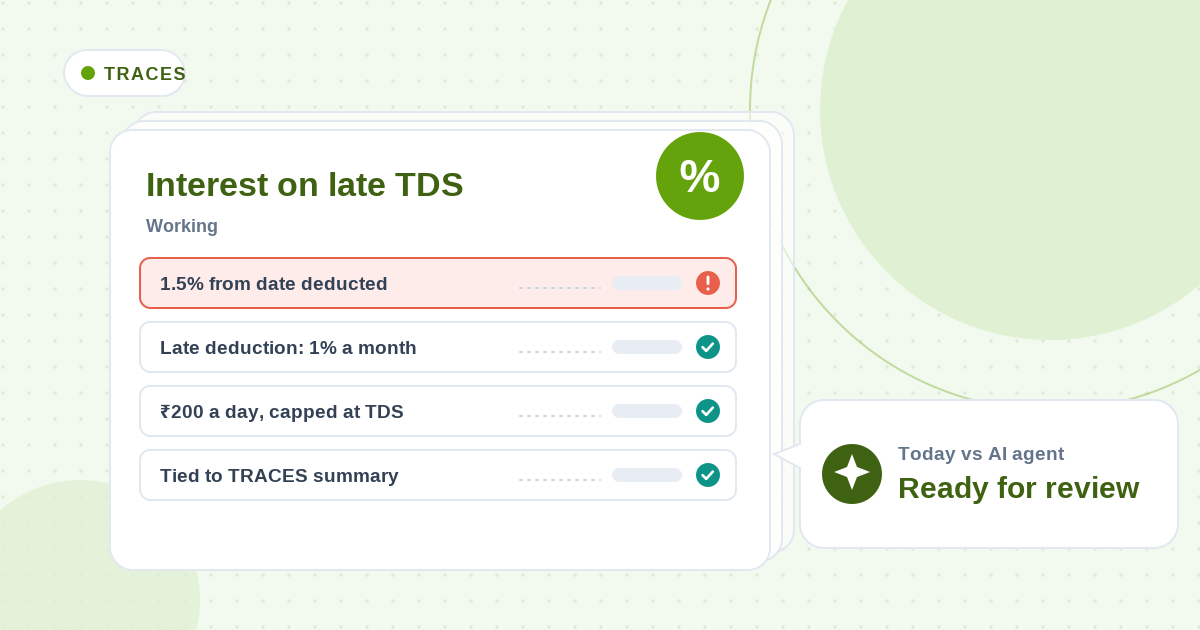
- Late deduction: 1% a month or part of a month on the TDS, from the date it was deductible to the date it was deducted (section 398(3)(a)(i)).
- Late payment: 1.5% a month or part of a month, from the date it was deducted to the date it was paid (section 398(3)(a)(ii)). Once the 7th is missed, it runs from the deduction date, not from the 7th.
- Count each month or part of a month as a full month. Calculators differ on whether that means calendar months or 30-day periods, so compare your figure with the TRACES default summary.
- Late return: ₹200 for every day the return is late, up to the TDS in the return (section 427, it was 234E). The interest and the fee must both be paid before the return is delivered.
- Pay on e-Pay Tax under Income Tax Act 2025 with the TAN and mobile OTP, on the TDS challan (ITNS 281N): tax year 2026-27, company or other deductees, resident or non-resident, and the nature of payment, with the interest and fee in their own fields. Download the challan.
- If the return was already processed with a default, open the default summary on TRACES: short payment, interest on late deduction, interest on late payment and the late fee. Then start a correction: the form, tax year and quarter, Correction, Add Challan, and import the new challan from the unconsumed challans.
- Allocate the challan to interest and fee, validate and submit, and e-verify with Aadhaar OTP or a DSC. Check that the next processing result clears the default.
Interest and fees for late TDS under the Income-tax Act 2025
| Default | Section (old) | Charge | Period or condition |
|---|---|---|---|
| Deducted late | 398(3)(a)(i) (201(1A)) | 1% a month or part of a month | From when it was deductible to when it was deducted |
| Deducted, then paid late | 398(3)(a)(ii) (201(1A)) | 1.5% a month or part of a month | From when it was deducted to when it was paid |
| Return filed late | 427 (234E) | ₹200 a day, up to the TDS in the return | Each day the failure continues |
| Return late or wrong | 461 (271H) | Penalty of ₹10,000 to ₹1,00,000 | None for lateness if tax, fee and interest are paid and the return is filed within one month of the due date |
A worked example
A made-up Nagpur company credits September office rent of ₹4,00,000 to its landlord on 1 September 2026. TDS at 10% is ₹40,000, deductible that day. The accountant deducts it only on 30 October 2026, when the rent is paid, and deposits it on 7 November, on time for an October deduction. Late deduction runs from 1 September to 30 October, two months: 1% × 2 × ₹40,000 = ₹800.
On 2 November 2026 it deducts ₹25,000 from a consultant's fee. That is due by 7 December but paid on 30 December. Interest runs from the deduction date, 2 November, to 30 December, two months: 1.5% × 2 × ₹25,000 = ₹750. For both items, calendar months and 30-day periods give the same count.
The October to December Form 140 is due 31 January 2027 and is filed on 16 March 2027, 44 days late (1 February to 16 March). The fee is 44 × ₹200 = ₹8,800, well under the ₹1,85,000 of TDS in the return. The company pays ₹1,550 interest and the ₹8,800 fee, ₹10,350 in all, before filing.
Because it filed more than a month after the due date, the section 461 relief no longer applies, and a penalty of ₹10,000 to ₹1,00,000 is possible. Filing by 28 February, with the fee and interest paid, would have avoided that and cut the fee to ₹5,600 for 28 days.
Where it usually goes wrong
- Counting the 1.5% from the 7th instead of from the date of deduction.
- Missing late deduction on provisions and advance rent, where the credit comes before the payment.
- Paying the interest but leaving it in the tax column of the challan or the return, so TRACES still shows a short payment.
- Paying under the 1961 Act option (ITNS 281) for a 2026-27 default. Tax year 2026-27 payments go on ITNS 281N.
- One challan for company and other deductees, or for residents and non-residents. The portal needs separate challans.
- Filing the return first and paying the fee later. Section 427 says the fee is paid before the return is delivered.
- Booking the interest to the TDS payable account. It is the firm's own cost, not tax deducted from anyone.
How an AI agent does it
Each person on the team gets their own AI agent, used from Slack, WhatsApp or a web app. It has its own files, spreadsheets and a real web browser: it reads the Excel, CSV, PDF and Tally exports you give it and writes its working in Excel. On a portal you sign in yourself, in its browser window, with your own password and OTP. It asks before it changes, sends, files or pays anything, and every step is logged. This section describes how it would work out the interest and fee and prepare the correction. It can be wrong, so the last sections say what you still check.
What you give it
- The TRACES default summary or justification report, which it can download after you sign in
- The quarter's TDS working with credit, deduction and payment dates, exported from Tally in Excel
- The e-Pay Tax payment history and the challan copies
- The return as filed, or the quarter's Form 140 or 138 working
What it does
- For each deductee row, takes the credit, deduction and payment dates from the books and the challans, and finds the date the tax was deductible.
- Works out 1% for late deduction and 1.5% for late payment, counting each part month as a month, and shows the count for each row.
- Compares its figures, row by row, with the TRACES default summary, and lists any difference with the dates behind it.
- Works out the section 427 fee from the due date and the filing date, capped at the TDS, and notes whether the one-month window in section 461 was met.
- Prepares the challan breakdown: interest and fee separately, split by company and other deductees, residents and non-residents.
- After you sign in to TRACES in its browser, fills the correction up to Validate and submit: adds the challan and allocates it to interest and fee. Then it stops.
- Drafts the journal entry for the interest and fee as import-ready Excel or XML for Tally, with a note of the dates that caused the default.
What it hands back
- An interest working: one row per deduction with the three dates, the months counted and the interest
- A reconciliation to the TRACES default summary
- The challan amounts to pay, split as the portal needs
- A correction checklist and a draft journal entry
What it leaves to you
- Pay the interest or the fee.
- Submit or e-verify the correction.
- Decide whether to contest a demand you think is wrong. It lists the rows; you decide.
- Post the entry into Tally. Your team imports it after review.
Today vs with an AI agent
| Step | Today | With an AI agent |
|---|---|---|
| Gathering the inputs | You download the default summary, then dig out invoice, deduction and challan dates. | You give it the default summary and the TDS working. It reads the dates from them. |
| The working | A sheet of dates, months and interest, often only for the rows TRACES flagged. | It works out every row, flagged or not, and shows the month count for each. |
| The cross-checks | Totals compared with the TRACES demand. | A row-by-row comparison with the TRACES default summary, with the dates behind each difference. |
| Exceptions | Rows that don't agree are often paid as demanded. | It lists rows where its figure and the TRACES figure differ, and why. |
| The output | A challan paid and a correction filed. | A challan breakdown, a correction filled up to submit, and a draft journal. |
| The review | A senior checks the challan amount. | You check the differences and the dates it relied on. |
| Who signs off | The responsible person pays and e-verifies. | The same person pays and e-verifies. It never submits. |
What you still check
- The dates it used, especially the credit date for provisions and advance rent.
- Any row where its interest differs from TRACES. The month count is the usual cause.
- Whether to pay a demand or correct the return first, when the default comes from a data error rather than a late payment.
- The challan details before you pay: tax year, TAN and the deductee type.
- Why the deduction was late, so it doesn't happen again next quarter.
Questions accountants ask
How is interest on late payment of TDS calculated?
1.5% of the TDS for every month or part of a month, from the date it was deducted to the date it was paid. ₹25,000 deducted on 2 November and paid on 30 December is two months: ₹750.
What is the interest for late deduction of TDS?
1% a month or part of a month, from the date the tax was deductible to the date it was deducted, under section 398(3)(a)(i) of the Income-tax Act 2025. It was section 201(1A).
How is the 234E late fee worked out now?
Section 234E is section 427 of the Income-tax Act 2025: ₹200 for each day the return is late, up to the TDS in the return. A return 44 days late costs ₹8,800.
How do I pay the TDS return late fee?
On e-Pay Tax, choose Income Tax Act 2025, enter the TAN and the mobile OTP, and pay on the TDS challan (ITNS 281N) with the fee in its own field. Then allocate the challan to the fee in the return or in a correction.
Is there an interest on late payment of TDS calculator?
Many online calculators exist, but they count months differently. Work it row by row with the three dates and compare with the TRACES default summary, which the demand is based on.
Does the agent pay the interest or file the correction?
No. It works out the interest and fee and fills the correction after you sign in, then stops. You pay, submit and e-verify yourself.
Hand this job to an agent
Bring one of your own files to a 30-minute call and watch an agent do this job.
Book a 30-min demo