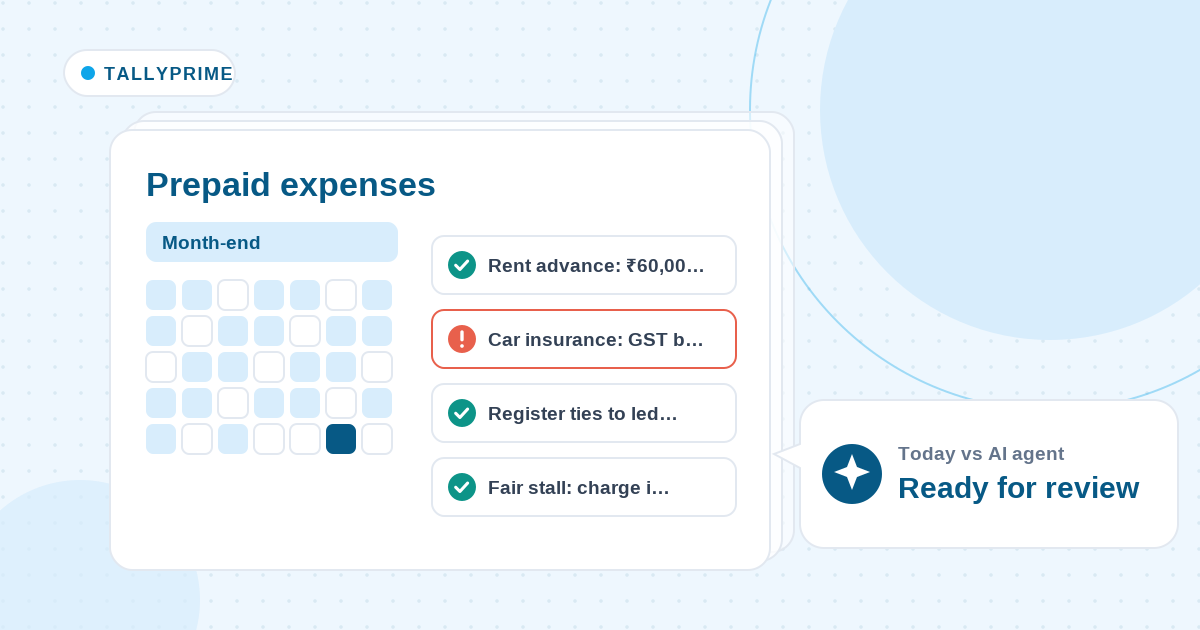
Short answer: Prepaid expenses are bills paid for a future period, such as six months' rent or a year's insurance. Debit a prepaid expenses ledger, net of any GST you claim as credit, then each month debit the expense and credit the prepaid with one month's share. Keep a register of every advance bill and tie its balance to the ledger at each month-end.
Advance bills are easy to book and easy to forget. A year's insurance or six months' rent goes to expense on the day it is paid, that month's profit and loss is wrong, and the fix waits for a year-end adjustment. With several advance bills, GST that may or may not be claimable, and TDS on some of them, a register is the only way to keep each month's accounts right.
This post follows a recent TallyPrime tutorial on advance rent, adds the register, GST, TDS and the 31 March view, and works a month-end for a made-up distributor. Then it explains how an AI agent would keep the register and draft the monthly entry. It is the mirror image of accrued expenses, where the cost comes before the bill.
The tutorial this is based on
Tally Prime Interview Questions | Advance Rent entry in Tally Prime #tally by Tally with Rahul Chaudhary, published 21 January 2026 (in Hindi). He pays six months' shop rent of ₹60,000 in advance, shows why booking it all to rent overstates January, moves ₹50,000 to a prepaid ledger under Current Assets by journal, and releases ₹10,000 in February. His figures are right. He also counts salary paid ahead as a prepaid expense, but pay advanced to staff is an advance recoverable from them. He dates releases on the 10th, the rent date, where month-end is usual, and leaves out GST, TDS, a register and the year-end view, which we added. At ₹10,000 a month his rent is under the TDS threshold, so none was due. For the year-end-only method, Vishesh TechEducation's Prepaid Expenses Entry In Tally Prime (29 March 2026, in Hindi) is clear, but it counts June 2025 to March 2026 as 9 months. It is 10, so its ₹30,000 prepaid at 31 March 2026 should be ₹20,000.
How do you pass the prepaid expenses journal entry in TallyPrime?
- Create a ledger for prepaid expenses. The tutorial puts it under Current Assets. TallyPrime also has a Loans & Advances (Asset) group, which matches where the ICAI Guidance Note puts prepaid expenses under Schedule III Division I: short-term loans and advances.
- Book the payment. The tutorial pays ₹60,000 by Payment voucher (F5) to Shop Rent, then passes a Journal (F7) moving ₹50,000 to Prepaid Rent. Debiting the prepaid ledger directly at payment does the same, with one entry fewer to forget.
- If GST credit is available, the prepaid is the value before GST, and the GST goes to input CGST and SGST, or IGST. If the credit is blocked under s.17(5), for example on insurance of a staff car or a club membership, the GST is part of the prepaid cost.
- If TDS applies, deduct it when the advance is paid or credited, whichever is earlier, and not month by month as it is released (s.393(1)(c) of the Income-tax Act 2025). For rent the threshold is ₹50,000 for a month (Table Sl. 2; it was 194-I). TDS on rent has the rates.
- Release one month's share each month by Journal (F7): debit the expense, credit prepaid expenses. Date it on the last day of the month. In the tutorial, February's ₹10,000 leaves ₹40,000 prepaid; with a 31 March year-end, ₹30,000 for April to June would still be prepaid at 31 March 2026.
- Keep a register in Excel, one row per bill: vendor, bill number and date, what it is for, amount before GST, GST and whether credit is claimed or blocked, TDS and its date, period from and to, months, monthly charge, charged to date and balance.
- At each month-end, total the month's charges into one journal and tie the register's balance to the prepaid ledger in the trial balance. Opening plus additions less releases should equal closing.
- At 31 March, split each balance between the part used within 12 months and the part beyond. Under Division I the first is short-term and the second long-term loans and advances. Under Ind AS (Division II) they are other current and other non-current assets. The Schedule III format post shows the headings.
- Some firms adjust only at year-end: one journal on 31 March for the unexpired part, reversed on 1 April. Pick one method for each bill, never both.
Prepaid expense entries in TallyPrime
| Event | Debit | Credit | TallyPrime voucher |
|---|---|---|---|
| Advance bill paid, GST credit available | Prepaid expenses (value before GST); input CGST and SGST, or IGST | Bank; TDS payable if TDS applies | Payment (F5), or Journal (F7) for the bill, then Payment |
| Advance bill paid, GST credit blocked under s.17(5) | Prepaid expenses (value plus GST) | Bank; TDS payable if TDS applies | Payment (F5) |
| Month-end release, one month's share | The expense (rent, insurance) | Prepaid expenses | Journal (F7), dated the last day of the month |
| Year-end-only method, 31 March | Prepaid expenses (unexpired part) | The expense | Journal (F7) |
| Year-end-only method, 1 April | The expense | Prepaid expenses | Journal (F7) |
| Contract cancelled, refund received | Bank | Prepaid expenses (unexpired part) | Receipt (F6) |
A worked example: the November 2026 close
A made-up Nagpur distributor closes November 2026 with four advance bills on its register. Stock and fire insurance of ₹96,000 plus IGST of ₹17,280 covers 1 September 2026 to 31 August 2027. The credit is claimed, so the prepaid is ₹96,000, or ₹8,000 a month: ₹24,000 charged by November and ₹72,000 left.
Warehouse rent of ₹3,60,000 plus CGST and SGST of ₹32,400 each covers 1 October 2026 to 31 March 2027 and was paid on 1 October: ₹60,000 a month, ₹1,20,000 charged, ₹2,40,000 left. At ₹60,000 a month it is over the ₹50,000 threshold, so TDS at 10% was deducted when the advance was paid, on all six months at once. TDS changes what the landlord received, not the prepaid.
Car insurance of ₹36,000 plus GST of ₹6,480 runs from 1 August 2026 to 31 July 2027. The car is used by staff, not for any purpose that allows the credit, so the GST is blocked under s.17(5)(ab) and the prepaid is ₹42,480: ₹3,540 a month, ₹14,160 charged, ₹28,320 left. A trade-fair stall of ₹75,000, paid on 20 November for a fair on 15-17 February 2027, stays prepaid until February and is charged in full then.
November's journal debits Insurance ₹8,000, Warehouse rent ₹60,000 and Vehicle insurance ₹3,540, and credits Prepaid expenses ₹71,540. The register's balance is ₹3,40,320 for the three time-based bills and ₹4,15,320 with the stall, which must equal the prepaid ledger. At 31 March 2027, ₹54,160 will be left (insurance ₹40,000, car insurance ₹14,160), all within 12 months. A two-year hosting plan of ₹24,000 from 1 November 2026 would leave ₹19,000 then: ₹12,000 current and ₹7,000 non-current.
Where it usually goes wrong
- Counting months wrong. June to March is 10 months, not 9, and one month off moves a whole month's charge between years.
- Monthly releases plus a 31 March adjustment for the same bill, which charges it twice.
- Putting GST in the prepaid when the credit was also claimed, or leaving blocked GST out of it.
- Deducting TDS on each month's release instead of on the advance when it is paid or credited.
- Treating supplier advances for goods, refundable security deposits or salary advances as prepaid expenses. They are advances or deposits.
- Spreading a bill for a single event, such as a trade fair, over the months before it. It stays prepaid until the event.
How an AI agent does it
In this post an AI agent is a team member's own assistant, used from Slack, WhatsApp or a web app. It has its own files, spreadsheets and a real web browser, reads TallyPrime exports and PDF bills, and writes its working in Excel. It doesn't post into Tally; it prepares import-ready files for your team. It asks before it changes or sends anything, and every step is logged. This section describes how it would keep the prepaid register and draft the month-end entry. It can be wrong, so the last sections list what you check.
What you give it
- TallyPrime exports to Excel: the Day Book or ledger vouchers for the expense ledgers that carry advance bills, the prepaid expenses ledger and the trial balance
- The bills, policy schedules and rent agreements as PDFs
- Last month's register
- GSTR-2B, to see which credits were claimed, and the TDS ledger
- The firm's rule for small items, such as expensing anything under ₹10,000 directly, which it keeps in shared memory
What it does
- Reads each new bill and finds its period from the bill, policy or agreement. A bill with no period is flagged, not guessed.
- Puts every bill that runs past the month on the register and works out the monthly charge on the firm's convention, whole months or days.
- Checks the GST treatment: net of GST where credit is claimed, GST in the cost where it is blocked under s.17(5).
- Checks that TDS was deducted at payment where the kind of payment needs it.
- Rolls the register forward, drafts the month's release journal and ties the closing balance to the prepaid ledger.
- At 31 March, splits each balance into the part within 12 months and the part beyond.
- Can run on the last working day of each month on a schedule.
What it hands back
- The updated register in Excel, with the roll-forward
- The month's release journal as an import-ready file: Excel for a mapping template, or XML
- The tie-out of the register to the trial balance
- An exceptions list: bills with no period, blocked GST taken as credit, missing TDS, periods that don't match the policy, and bills fully used but still on the register
What it leaves to you
- Import or post the journal in Tally. Your team does that after review.
- Set the policy: monthly or daily, and what is too small to spread.
- Decide whether a doubtful credit is claimed.
- Decide the income-tax treatment of an advance. That stays with your tax adviser.
Today vs with an AI agent
| Step | Today | With an AI agent |
|---|---|---|
| Gathering the inputs | Bills and agreements found in folders when someone remembers them. | You give it the Tally exports, bills and last month's register; it keeps the firm's rules in shared memory. |
| The working | An Excel register updated by hand, or one adjustment at year-end. | It adds new bills from their documents and works out each bill's monthly charge. |
| The cross-checks | The prepaid ledger checked against the register at year-end. | It ties the register to the trial balance at every month-end. |
| Exceptions | Found when the auditor asks about a balance. | It lists bills with no period, wrong GST, missing TDS and bills fully used. |
| The output | A journal passed in Tally each month, if it is remembered. | An updated register, an import-ready journal and a tie-out. |
| The review | A senior checks the year-end balance. | You check the periods, the GST and TDS flags and the journal before import. |
| Who signs off | The accountant passes the entry. | You import and post. It posts nothing into Tally itself. |
What you still check
- Each period against the bill, policy or agreement, and the start-month convention applied the same way every time.
- That no bill is released twice, through monthly journals and a year-end adjustment.
- GST on a long service billed upfront, such as a 12-month policy. Most firms claim the whole credit when the invoice shows in GSTR-2B, but s.16(2) needs receipt of the service: that is practice, not settled law.
- TDS on each advance, including whether it was worked on the amount with or without GST.
- The current and non-current split, and any departure from the books for income tax, which is a call for the tax adviser.
Questions accountants ask
Are prepaid expenses current assets?
Yes, for the part used up within 12 months. Under Schedule III Division I they are shown in short-term loans and advances, with any part beyond 12 months in long-term loans and advances. Under Ind AS they are other current (or non-current) assets (ICAI Guidance Notes, 2022).
What is the journal entry for prepaid expenses with GST?
When the bill is paid: debit prepaid expenses with the value before GST and input GST with the tax, credit bank. Each month: debit the expense, credit prepaid expenses. If the credit is blocked under s.17(5), the GST is part of the prepaid amount.
Is TDS applicable on prepaid expenses?
It depends on what the payment is for, such as rent, professional fees or contract work, and its threshold. Where TDS applies, it is deducted when the advance is paid or credited, whichever is earlier, not as the expense is released (s.393(1)(c)).
What is the prepaid expenses adjustment entry at year-end?
Debit prepaid expenses and credit the expense with the unexpired part on 31 March, then reverse it on 1 April. Or release it month by month instead, which keeps every month right (AS 1, accrual).
How do you make a prepaid expenses schedule in Excel?
One row per bill: amount, GST treatment, period from and to, months, monthly charge, charged to date and balance. Total the month's charges for the journal, and tie the balance to the prepaid ledger.
Is the GST on a prepaid bill claimed all at once or monthly?
All at once, not spread like the expense. In practice most firms claim it in the month the invoice shows in GSTR-2B, within the s.16(4) time limit, once the s.16(2) conditions are met.
Hand this job to an agent
Bring one of your own files to a 30-minute call and watch an agent do this job.
Book a 30-min demo