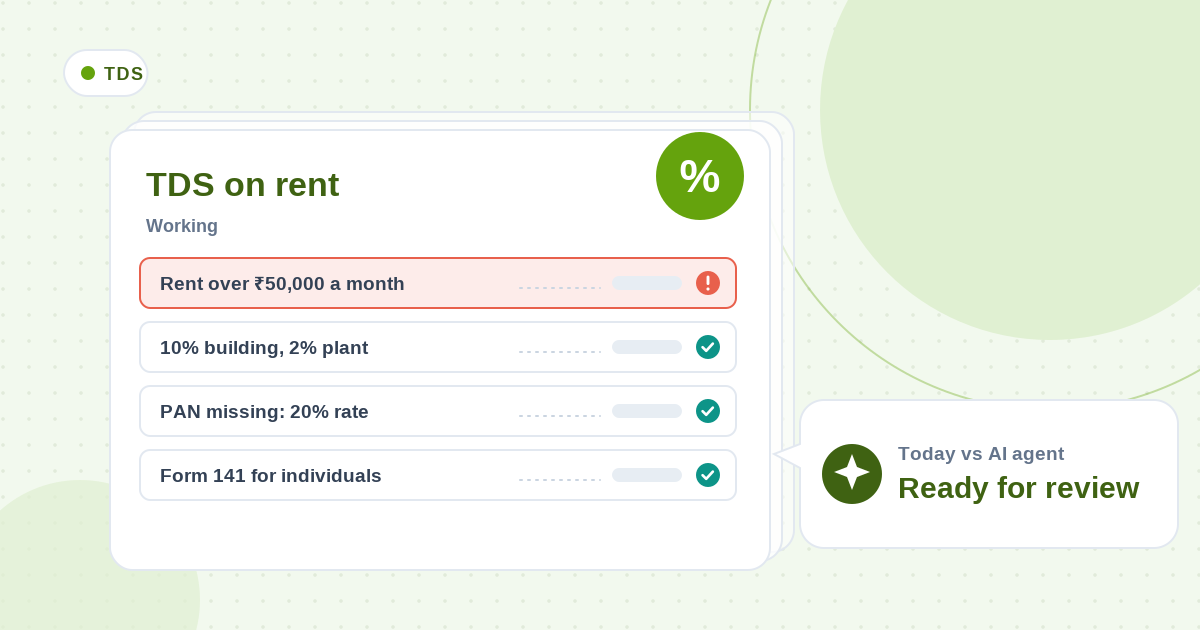
Short answer: TDS on rent is now section 393(1) Table Sl. 2. A business or other specified person deducts 10% on land, buildings, furniture and fittings, or 2% on plant and machinery, when rent is over ₹50,000 for a month, and deposits it by the 7th of the next month. Other individuals and HUFs deduct 2% once, in March or the tenancy's last month, and pay through Form 141.
Rent looks like the easiest TDS there is: a fixed amount every month. The trouble is that the same rent can fall under two different rows of the new section, with different rates, timing and forms, depending on who pays it. The ₹50,000 test is per month, not per year, and a landlord without a PAN changes the rate.
This post follows a recent tutorial on section 393(1), adds the rates table, the payment forms and a worked example, then explains how an AI agent would do the monthly working for a firm with several tenancies.
The tutorial this is based on
TDS on Rent FY 2026-27 | Section 393(1) | Income Tax Act 2025 | New TDS Rules | CA Shweta Verma by CA Shweta Verma, published 20 October 2026 (in Hindi). She explains both rows of section 393(1) Table Sl. 2 with the new numbers, and the rates and thresholds she gives match the Act. For the Tally entry, Info Times SG's TDS on Rent Entry in Tally Prime (15 October 2026, in Hindi) is useful, but it describes the threshold as ₹50,000 a month and ₹6 lakh a year: the Act has only the monthly test. We left out the payment code it uses, which we couldn't confirm on an official page.
How do you work out TDS on rent?
- Decide the row by looking at the payer. A specified person under section 402(37) is anyone other than an individual or HUF, or an individual or HUF whose turnover in the preceding tax year was over ₹1 crore (business) or ₹50 lakh (profession). Specified persons use Sl. 2(ii) (it was 194-I). Other individuals and HUFs use Sl. 2(i) (it was 194-IB).
- Check the threshold: TDS applies when the rent is over ₹50,000 for a month or part of a month. There is no yearly limit to test.
- For a specified person, the rate follows what is let: 2% for plant, machinery or equipment, and 10% for land, buildings (including factory buildings), land appurtenant, furniture or fittings.
- A specified person deducts every month when the rent is credited or paid, whichever is earlier, deposits it by the 7th of the next month on the TDS challan with its TAN, and reports it in Form 140 (it was 26Q).
- Under Sl. 2(i) the rate is 2% on any asset. Deduct once, from the rent for March or the last month of the tenancy, whichever comes first, on the rent for the whole period. The tutorial's example: ₹60,000 a month for 12 months gives ₹14,400, deducted in March.
- An individual or HUF needs no TAN for this. Pay within 30 days from the end of the month of deduction through Form 141 (it was 26QC), logged in with the PAN: e-File, e-Pay Tax, Income Tax Act 2025, New Payment, Form 141. Then download Form 132 (it was 16C) from TRACES and give it to the landlord.
- Without the landlord's PAN, deduct at the higher of the normal rate and 20% (section 397(2)(b)). Under Sl. 2(i), that can't exceed the last month's rent.
- Both rows cover rent paid to a resident, whether or not the payee owns the property.
TDS on rent: rates and thresholds for 2026-27
| Who pays | What is let | Rate | Threshold | When and how |
|---|---|---|---|---|
| Specified person, Sl. 2(ii) (was 194-I) | Land, building, land appurtenant, furniture, fittings | 10% | Over ₹50,000 for a month | Each month; deposit by the 7th; Form 140 |
| Specified person, Sl. 2(ii) (was 194-I) | Plant, machinery, equipment | 2% | Over ₹50,000 for a month | Each month; deposit by the 7th; Form 140 |
| Other individual or HUF, Sl. 2(i) (was 194-IB) | Any asset | 2% | Over ₹50,000 for a month | Once, in March or the last month of the tenancy; Form 141 within 30 days |
| Any payer, landlord without a PAN | Any | At least 20% | As above | Under Sl. 2(i), capped at the last month's rent |
A worked example
A made-up Pune engineering company rents an office for ₹1,20,000 a month and a generator for ₹75,000 a month. It is a specified person, so the office rent carries 10% (₹12,000) and the generator hire 2% (₹1,500), both being over ₹50,000 for the month. It deducts ₹13,500 each month, pays the landlord ₹1,08,000 and the hire firm ₹73,500, and deposits ₹13,500 by the 7th of the next month.
A salaried client of the firm, also made up, rents a flat for ₹55,000 a month from 1 April 2026 and leaves on 31 October 2026. As an individual with no business, the client falls under Sl. 2(i). Seven months' rent is ₹3,85,000, and TDS at 2% is ₹7,700, deducted from October's rent. Form 141 is due by 30 November 2026 and Form 132 by 15 December 2026.
If that landlord had no PAN, 20% of ₹3,85,000 would be ₹77,000. The cap is the last month's rent, so the TDS would be ₹55,000.
Where it usually goes wrong
- Treating ₹50,000 as a yearly ₹6 lakh limit. The test is each month, so a short tenancy at ₹55,000 a month is caught.
- Using 10% for machinery hire, or 2% for a building. The rate follows what is let.
- Deducting on payment when the rent was credited earlier, for example in a year-end provision. A specified person deducts at the earlier of the two.
- Asking an individual tenant to get a TAN. Sl. 2(i) payers don't need one; they pay through Form 141 with their PAN.
- One Form 141 for two months, or for a corporate and a non-corporate landlord. The portal needs a separate form for each.
- A landlord without a PAN taxed at 2% or 10%, or, for an individual payer, 20% applied without the cap at the last month's rent.
- Calling Form 141 a return. It is a challan-cum-statement; the quarterly returns are Forms 138, 140, 144 and 143.
How an AI agent does it
Each person on the team gets their own AI agent, used from Slack, WhatsApp or a web app. It has its own files, spreadsheets and a real web browser: it reads the Excel, CSV, PDF and Tally exports you give it and writes its working in Excel. On a portal you sign in yourself, in its browser window, with your own password and OTP. It asks before it changes, sends, files or pays anything, and every step is logged. This section describes how it would do the monthly rent TDS working for a firm with several tenancies. It can be wrong, so the last sections say what you still check.
What you give it
- The rent agreements, as PDFs
- The rent and landlord ledgers exported from Tally in Excel
- The landlord list with PANs, and last year's turnover for any individual or HUF client
- The challans already paid, from the e-Pay Tax payment history
What it does
- Reads each agreement: the landlord, PAN, monthly rent, what is let, start and end dates, and any escalation.
- Decides the row for each payer from the turnover you give, and the rate from what is let, and shows its reasoning for each agreement.
- Works out each month's TDS, tests the ₹50,000 threshold month by month, and flags any landlord without a PAN at 20%, with the cap for Sl. 2(i).
- Matches the TDS in the books to its working and to the challans, and lists months that are short or paid late, with the interest worked out.
- Prepares the journal entries as import-ready Excel or XML for your team to import into Tally after review.
- For an individual tenant, prepares the Form 141 details and, after you sign in, fills the form up to the final step and stops.
- Keeps each client's agreements, landlord PANs and rates in the firm's shared memory, and can run on the 3rd of every month.
What it hands back
- A rent TDS working: one row per agreement and month, with the row, rate and TDS
- An exceptions list: missing PANs, rent over ₹50,000 with no TDS, wrong rates, short or late deposits
- Import-ready journal entries for Tally
- The Form 141 details and the deposits due by the 7th
What it leaves to you
- Pay the challan or submit Form 141.
- Decide whether a mixed agreement, such as a warehouse with handling services, is rent or a contract.
- Post entries into Tally. Your team imports them after review.
- Contact a landlord about a PAN without your approval.
Today vs with an AI agent
| Step | Today | With an AI agent |
|---|---|---|
| Gathering the inputs | You pull the agreements, the rent ledger and the landlord PANs from different folders. | You give it the agreements, ledgers and PANs once. It keeps them in the firm's shared memory. |
| The working | A monthly sheet: rent, rate and TDS for each landlord. | It builds the same sheet from the agreements, with the row and rate reasoned for each one. |
| The cross-checks | TDS in the books against the sheet, and challans against the payment history. | It ties the books, the working and the challans month by month. |
| Exceptions | Found when someone notices a missing PAN or a month with no TDS. | It lists missing PANs, months over ₹50,000 with no TDS, wrong rates and late deposits. |
| The output | Entries passed in Tally and challans paid. | A working, import-ready entries and Form 141 details. Your team imports and pays. |
| The review | A senior checks the rates and the totals. | You check its row and rate choices and the exceptions. |
| Who signs off | The accountant or the client pays and files. | You pay and file. It stops before submitting anything. |
What you still check
- The payer test for individual and HUF clients: last year's turnover decides the row, and the agent uses the figure you give it.
- Agreements that mix rent with services, such as co-working spaces or warehousing.
- Each PAN it flagged, and whether the landlord can supply one before the deduction.
- The first month of a new agreement and any escalation clause.
- The Form 141 details before you submit, since corrections can be made only on TRACES.
Questions accountants ask
What is the TDS on rent limit for 2026-27?
Rent over ₹50,000 for a month or part of a month. There is no separate yearly limit under section 393(1).
Which section covers TDS on rent in 2026-27?
Section 393(1) Table Sl. 2 of the Income-tax Act 2025. Sl. 2(ii) replaces 194-I for businesses and other specified persons, and Sl. 2(i) replaces 194-IB for other individuals and HUFs. Pick the payment code from the list on the portal or in the utility.
How many percent TDS on rent?
For specified persons, 10% on land, buildings, furniture and fittings, and 2% on plant, machinery and equipment. Other individuals and HUFs deduct 2% on any asset. Without the landlord's PAN, at least 20%.
How does an individual pay TDS on rent?
Deduct 2% once, from the rent for March or the last month of the tenancy, and pay it within 30 days from the end of that month through Form 141, logged in with your PAN. No TAN is needed. Then download Form 132 from TRACES for the landlord.
Does the agent pay the TDS or file Form 141?
No. It works out the TDS and fills the form after you sign in, then stops. You pay and submit yourself.
Hand this job to an agent
Bring one of your own files to a 30-minute call and watch an agent do this job.
Book a 30-min demo