Short answer: The Schedule III Division I balance sheet format, for companies that follow the Accounting Standards, lists equity and liabilities first (shareholders' funds, non-current liabilities, current liabilities), then non-current and current assets. Map each trial balance ledger to one line, split balances into current and non-current, and add the notes required since FY 2021-22: ageing schedules, promoter shareholding and 11 ratios.
A trial balance is a list of ledgers in Tally's groups. Schedule III wants a fixed set of lines in a fixed order, each balance split between what falls due within 12 months and what doesn't, and notes Tally doesn't keep, such as creditor ageing from the due date and promoter shareholding. Most of the work is the mapping.
Here is the method from a recent TallyPrime tutorial, the format with the Tally groups that usually feed each line, a worked example of the splits that trip people up, and how an AI agent would do the job from the exports. This post is for companies. For firms and LLPs, see the ICAI format for non-corporate entities.
The tutorial this is based on
Generating Schedule III Division I Financial Statements in TallyPrime 7.1| Complete Guide by RTS Professional Study, published 6 July 2026 (in Hindi). A walkthrough of TallyPrime 7.1's Financial Statements add-on: export the trial balance to the Excel template, fill in the company, directors and share capital, map both years' ledgers to Schedule III heads, then generate the balance sheet, statement of profit and loss and notes. It doesn't show the disclosures added from FY 2021-22, such as the ageing schedules, promoter shareholding and the ratios note, so we add them. Tally Solutions' own video of the same flow (here) says the exported Excel has no formulas.
How do you put a trial balance into the Schedule III balance sheet format?
- Check the division. Division I is for companies that follow the Accounting Standards. Ind AS companies use Division II, and NBFCs on Ind AS use Division III.
- Export both years' trial balances, ledger-wise. The tutorial turns on the Financial Statements add-on in TallyPrime 7.1 and exports to its Excel template, with debtors and creditors party-wise or bill-wise.
- Fill in the company, its directors and their DINs, the auditor and the signing date, then the share capital: each class, the number of shares and who holds them.
- Map every ledger to a Schedule III line by what it is, not by its Tally group. In the tutorial a director's loan becomes a borrowing from a related party, salary, TDS and GST payable go to other current liabilities, and advance tax is netted against the provision for tax.
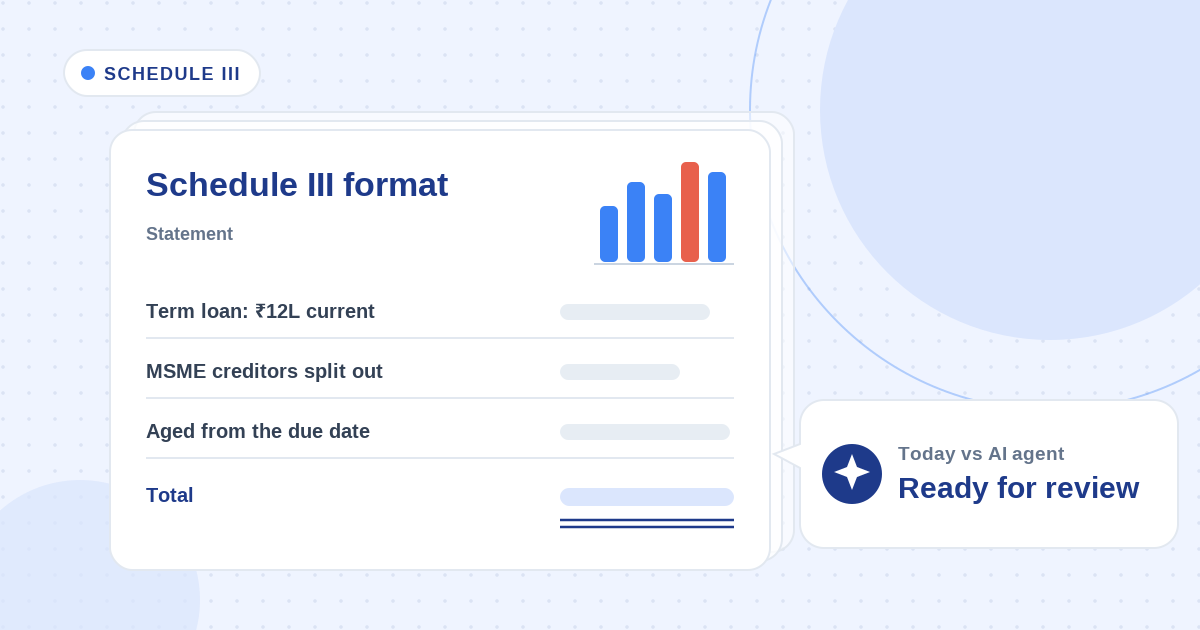
- Split each balance into current and non-current. A liability is current if it is due within 12 months or the operating cycle, or if the company has no unconditional right to defer it for 12 months. Term-loan instalments due in the next 12 months go under short-term borrowings as current maturities.
- Record adjustments not yet booked in Tally, such as depreciation, as provisional entries. Map the previous year, map any ledger still unmapped, and generate the statements and notes.
- Add the ageing the video doesn't show. Trade payables: MSME, others and disputed dues of each, aged under 1 year, 1-2, 2-3 and over 3 years from the due date. Trade receivables: undisputed and disputed, each considered good or doubtful, aged under 6 months, 6 months to 1 year, 1-2, 2-3 and over 3 years.
- Add the other 2021 disclosures: promoter shareholding, CWIP ageing, 11 ratios with a reason for any that moved more than 25%, and the additional regulatory information, such as whether quarterly returns to the bank agree with the books.
- Check that both years balance, profit agrees with the trial balance, last year's figures agree with the signed statements, and no Suspense A/c or "Difference in opening balances" is left.
Schedule III Division I balance sheet format: the lines in order
| Head | Lines, in order | Tally ledgers that usually go here |
|---|---|---|
| Shareholders' funds | Share capital; reserves and surplus; money received against share warrants | Capital Account; Reserves & Surplus; the Profit & Loss A/c balance |
| Share application money pending allotment | One line | Money received for shares not yet allotted |
| Non-current liabilities | Long-term borrowings; deferred tax liabilities (net); other long-term liabilities; long-term provisions | Secured and Unsecured Loans due after 12 months; deferred tax; gratuity and leave provisions not due within 12 months |
| Current liabilities | Short-term borrowings, including current maturities of long-term borrowings; trade payables, split into micro and small enterprises and others; other current liabilities; short-term provisions | Bank OD and cash credit; loan instalments due within 12 months; Sundry Creditors; Duties & Taxes, salary payable, customer advances; provision for tax net of advance tax |
| Non-current assets: property, plant and equipment and intangible assets | Property, plant and equipment; intangible assets; capital work-in-progress; intangible assets under development | Fixed Assets ledgers net of depreciation, with the gross block in the note; CWIP ledgers |
| Non-current assets: the rest | Non-current investments; deferred tax assets (net); long-term loans and advances; other non-current assets | Investments held long term; deferred tax asset; capital advances; security deposits (other non-current assets since 2021) |
| Current assets | Current investments; inventories; trade receivables; cash and cash equivalents; short-term loans and advances; other current assets | Stock-in-Hand; Sundry Debtors; Cash-in-Hand and Bank Accounts; advances to suppliers, GST and other balances with government authorities; interest accrued |
A worked example: three balances that need splitting
A made-up Indore packaging company that follows the Accounting Standards has these balances at 31 March 2026: a term loan of ₹48,00,000, with ₹12,00,000 of principal due by March 2027; a director's loan of ₹15,00,000 with no repayment terms; cash credit of ₹25,00,000; a FY 2025-26 tax provision of ₹9,40,000, against advance tax of ₹8,00,000 and TDS of ₹60,000; and Sundry Creditors of ₹31,50,000 net, which is ₹31,95,000 of credit balances (₹6,20,000 owed to micro suppliers) less a ₹45,000 advance to one supplier.
Long-term borrowings are ₹36,00,000. Short-term borrowings are ₹52,00,000: cash credit ₹25,00,000, current maturities ₹12,00,000 and the director's loan ₹15,00,000, shown as a loan from a related party. With no terms it is repayable on demand, so it is current, unless the director agrees in writing not to ask for it for 12 months.
The tax provision nets to ₹80,000 under short-term provisions. Trade payables are ₹31,95,000: ₹6,20,000 to micro and small enterprises and ₹25,75,000 to others. The ₹45,000 advance moves to short-term loans and advances, so both sides of the balance sheet are ₹45,000 higher than Tally's net group shows.
Where it usually goes wrong
- Leaving the next 12 months' term-loan instalments in long-term borrowings, or in other current liabilities, where they went before 2021.
- Showing Sundry Creditors as one figure. The face of the balance sheet splits micro and small enterprises from others, so the creditor masters need MSME status.
- Netting a supplier's debit balance or a customer's credit balance inside the group. An advance to a supplier is a loan or advance; an advance from a customer is another current liability.
- Ageing from the invoice date. Schedule III ages from the due date, and from the transaction date only when there is no due date.
- Leaving security deposits in long-term loans and advances. Since 2021 they go to other non-current assets.
- Treating the template's Excel export as the working. It has no formulas, so a late entry means generating it again.
How an AI agent does it
An AI agent here is an assistant each person on the team gets, used from Slack, WhatsApp or a web app. It has its own files, spreadsheets and a browser, reads Tally exports in Excel or XML, and writes working files in Excel. This section describes how it would draw up the balance sheet and notes. It asks before it changes, posts or sends anything, and every step is logged.
What you give it
- Both years' trial balances from TallyPrime, ledger-wise, in Excel or XML.
- The bill-wise outstanding reports for creditors and debtors, with due dates, and each creditor's MSME status.
- Last year's signed financial statements (PDF).
- The loan repayment schedules, the fixed asset register, the tax working and the register of members.
What it does
- Maps each ledger to a Schedule III line, starting from the mapping kept for this client in the firm's shared memory, and lists every new ledger for you to confirm.
- Splits each loan into long-term borrowings and current maturities from its repayment schedule, and asks about any loan with no terms.
- Moves debit balances out of creditors and credit balances out of debtors, and splits trade payables into MSME and others.
- Ages creditors and debtors from the due dates into the Schedule III buckets, and lists bills with no due date.
- Works out the 11 ratios for both years and lists each one that moved more than 25%, with its numerator and denominator.
- Checks that both years balance, profit agrees with the trial balance and last year agrees with the signed PDF, then writes the statements and notes with formulas linked to the mapping sheet.
What it hands back
- An Excel workbook: mapping sheet, balance sheet, statement of profit and loss and notes for both years, with live formulas.
- An exceptions list: unmapped ledgers, loans with no terms, bills with no due date, creditors with no MSME status.
- Draft reclassification entries as an import-ready Excel or XML file, for your team to import into Tally after review.
What it leaves to you
- It doesn't post into Tally. Your team imports the entries after review.
- It doesn't make the judgement calls: the operating cycle, whether a due is disputed, whether a loan can be deferred.
- It doesn't approve or sign the statements, and it files nothing with the Registrar of Companies.
Today vs with an AI agent
| Step | Today | With an AI agent |
|---|---|---|
| Gathering the inputs | Export both trial balances to Tally's template, and collect loan schedules, ageing and last year's statements by email. | You give it the same exports and PDFs. It lists anything missing, such as due dates. |
| The working | Map each ledger in the template by hand, then generate flat statements. | Maps ledgers from last year's saved mapping, asks about new ones, and builds the statements with formulas. |
| The cross-checks | Tick totals, profit and last year's figures against the signed PDF by hand. | Checks both years balance, profit agrees, and last year matches the signed PDF. |
| Exceptions | Debit-balance creditors, loans without terms and missing due dates surface during review, if at all. | Lists them first: debit balances, loans without terms, bills without due dates, unknown MSME status. |
| The output | Statements and notes as PDF or flat Excel, with the 2021 disclosures added separately. | One workbook with statements, notes, ageing, promoter table and ratios, plus draft entries. |
| The review | The manager reviews the mapping and the notes line by line. | The manager reviews the exceptions and every proposed reclassification before anything is imported. |
| Who signs off | The board approves the statements, the directors sign, and the auditor reports. | The same. The agent prepares the draft and signs nothing. |
What you still check
- The operating cycle you use for the current and non-current split, and any loan whose terms don't say when it is due.
- Whether any creditor or debtor balance is disputed. Disputed dues are aged separately, and only the company knows which they are.
- Each supplier's MSME status from the Udyam certificate, and the interest note under the MSMED Act if a bill is overdue. See 43B(h) and clause 22.
- The explanation for each ratio that moved more than 25%. The agent gives the figures; the reasons are yours.
- The tax netting: advance tax and TDS set off only against the same year's provision.
Questions accountants ask
What is the balance sheet format as per the Companies Act 2013?
It is in Schedule III. Division I is for companies that follow the Accounting Standards, Division II for Ind AS companies and Division III for NBFCs on Ind AS. Division I lists equity and liabilities first, then assets, in the order in the table above.
Is there a Schedule III balance sheet format in Excel?
TallyPrime 7.1's Financial Statements add-on exports the trial balance to an Excel template with the notes. Tally's own video says the exported Excel has no formulas, so keep your mapping sheet. Any template works if it follows Division I's lines and notes.
Which notes to accounts go with a Schedule III balance sheet?
A note for each line: share capital with promoter shareholding, reserves, borrowings with their security and repayment terms, payables and receivables with ageing, and so on. Since FY 2021-22 there is also the additional regulatory information, including 11 ratios.
Does Schedule III apply to partnership firms and LLPs?
No, it is for companies. Firms and proprietorships follow ICAI's Guidance Note for non-corporate entities, and LLPs have a Guidance Note of their own: see the new ICAI format.
Hand this job to an agent
Bring one of your own files to a 30-minute call and watch an agent do this job.
Book a 30-min demo