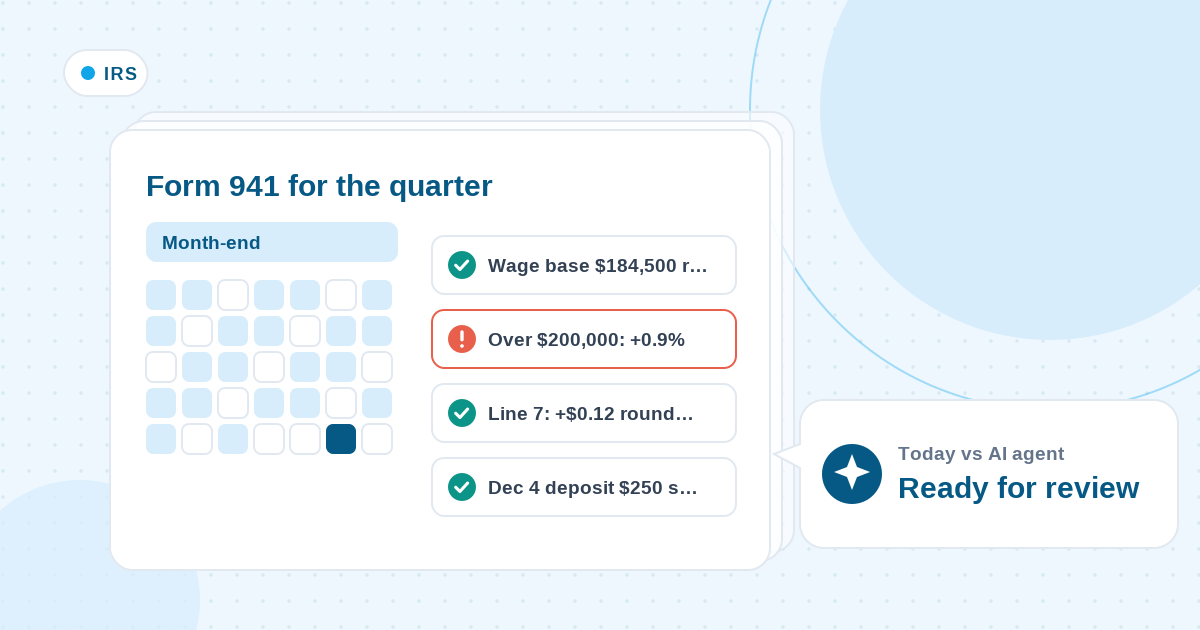
Short answer: Form 941 reports a quarter's wages, income tax withheld and both shares of social security and Medicare. For Q4 2026 it's due Monday, February 1, 2027, or February 10 if every deposit was on time and in full. Work from the payroll register: social security stops at $184,500 per employee, Additional Medicare starts over $200,000, and liabilities by pay date must total line 12.
Form 941 is mostly arithmetic. The work is in the inputs: social security that stops partway through December for a high earner, Additional Medicare from the payday that crosses $200,000, a few cents of rounding, and liabilities that must add up to the return by pay date. Q4 is where they meet, with year-end bonuses on top.
Here are the deposit rules from a CPA-exam lecture, the steps from the payroll register to each line, a worked quarter, then how an AI agent would prepare the return. Tying the register to the ledger and bank comes first: see payroll reconciliation.
The tutorial this is based on
Form 941 Explained Payroll Taxes — CPA Exam REG | Enrolled Agent Exam by Farhat Lectures, published 12 March 2026. An exam-style lecture for the CPA REG and Enrolled Agent exams: EFTPS, monthly and semiweekly deposits, the lookback period and the $2,500 and $100,000 rules, then one quarter worked on the 2026 form from payroll totals to the balance due. It doesn't cover Part 2 or Schedule B, line 7, the 2026 wage base or Additional Medicare, so the steps below add them. Two rules are shortened: the $2,500 rule applies when line 12 is under $2,500 for this quarter or the last, with no $100,000 day, and paying a small shortfall with the return, as in its example, suits a monthly depositor, while a semiweekly depositor deposits it by the makeup date. With auto-captions on, take the figures from the slides. Where a payroll provider files the return, Candus Kampfer's QuickBooks Online video (October 2026) shows where to preview it.
How do you fill out Form 941 from the payroll register?
- Confirm the deposit schedule, as the lecture does. For 2026 the lookback period is July 1, 2024 to June 30, 2025: $50,000 or less of 941 taxes means monthly, more means semiweekly, however often you pay. Monthly deposits are due by the 15th of the next month; semiweekly ones by the Wednesday after a Wednesday-to-Friday payday, or the Friday after a Saturday-to-Tuesday one. $100,000 owed on any day is due the next business day.
- Export the register for October to December by pay date and employee, with year-to-date social security and Medicare wages before October. On the March 2026 form, tick box 4, and leave the new Aggregate Return Filers Only boxes blank unless you file an aggregate return as an agent or third party.
- Line 1 is the employees paid for the pay period including December 12. Line 2 is W-2 box 1 wages: gross less pre-tax 401(k) and section 125, not gross pay. Line 3 is federal income tax withheld.
- Line 5a is social security wages, capped at $184,500 per employee for the year, times 0.124 (6.2% from each side); tips go on 5b. Line 5c is all Medicare wages, uncapped, times 0.029. 401(k) deferrals are in both, so 5c exceeds line 2 by the deferrals.
- Line 5d is each employee's wages above $200,000 for the year, from the payday that crosses it, times 0.009, with no employer share. Line 5e totals column 2, and line 6 is line 3 plus 5e (plus 5f, used only after an IRS notice on unreported tips).
- Line 7 is fractions of cents: the employee tax actually withheld, rounded check by check, less the share lines 5a to 5d imply, plus or minus. Line 10 combines lines 6 to 9, and line 12 is line 10 less any line 11 credit from Form 8974.
- Line 13 is the EFTPS deposits for tax period Q4 2026, plus any overpayment applied. Line 14 is the balance due, paid by EFT if you had to deposit; 15a is an overpayment. Never fill in both.
- Part 2, line 16: tick the first box if line 12 is under $2,500 for this quarter or the last, with no $100,000 day. Otherwise a monthly depositor enters each month's liability, and a semiweekly depositor attaches Schedule B, by day. List liabilities by pay date; they must total line 12.
- Parts 3 to 5: line 17 if you closed, line 18 if you're seasonal, an optional designee, and an authorized signer: the owner, a principal officer, a partner or an agent with a power of attorney. File by February 1, 2027, through IRS-approved software or an authorized e-file provider, or on paper, not both.
Form 941 lines from the payroll register (2026 form)
| Line | What goes there | From the payroll register | 2026 rule |
|---|---|---|---|
| 1 | Employees | Headcount, pay period including December 12 | Q4 reference date |
| 2 | Wages, tips, other compensation | Gross less pre-tax 401(k) and section 125 | Same as W-2 box 1 |
| 3 | Federal income tax withheld | Income tax column | Bonuses: optional flat 22% |
| 5a | Taxable social security wages | Social security wages, capped per employee | $184,500 cap; × 0.124 |
| 5c | Taxable Medicare wages and tips | Medicare wages, 401(k) included | No cap; × 0.029 |
| 5d | Additional Medicare wages | Each employee's wages over $200,000 for the year | × 0.009, employee only |
| 7 | Fractions of cents | Withheld less the employee share 5a to 5d imply | Plus or minus, cents |
| 12 | Total taxes after adjustments and credits | Line 10 less line 11 | Equals the Part 2 or Schedule B total |
| 13 | Total deposits for this quarter | EFTPS deposits for Q4 2026, plus overpayments applied | Line 14 or 15a, never both |
| 16 | Deposit schedule and tax liability | Liabilities by pay date | Lookback test: $50,000 |
A worked example: Q4 2026
A made-up Phoenix design studio has five employees, six semimonthly paydays in Q4 and semiweekly deposits. The owner-manager earns $8,000 a pay, defers $1,000 of it to the 401(k), had $144,000 of social security and Medicare wages before October, and gets a $40,000 bonus on December 15. The four staff have $2,137.50 to $3,350.00 a pay of those wages after a $150 section 125 premium each, one defers $175 a pay, and each gets a $1,000 bonus. Bonuses are withheld at the flat 22%.
On December 15 the owner-manager reaches the $184,500 wage base with $8,500 of the $48,000 paid, and passes $200,000 for the year: $24,000 of that payroll, and all $8,000 on December 31, carry Additional Medicare, $288.00.
The return: line 2, $150,470.00; line 3, $23,360.00; line 5a, $110,020.00 × 0.124 = $13,642.48; line 5c, $157,520.00 × 0.029 = $4,568.08; line 5d, $288.00; line 6, $41,858.56. Line 5c is $7,050.00 above line 2, the quarter's 401(k) deferrals. Rounding check by check withheld $0.12 more than the form implies, so line 7 is +$0.12 and line 12 is $41,858.68. Schedule B lists $5,174.78 on each October and November payday, $16,904.78 on December 15 and $4,254.78 on December 31, which total line 12.
The EFTPS history shows the deposit due December 4 as $250.00 short, more than the allowance: the greater of $100 or 2% of $5,174.78, which is $103.50. Deposit the $250 for tax period Q4 2026 and line 14 goes to zero. Made on January 8, 2027, 35 days late, it can draw a 10% penalty of $25.00 unless the IRS waives it, and the return is due February 1, not February 10.
Where it usually goes wrong
- Liabilities by deposit date instead of pay date. A December 31 payday is Q4, though deposited in January.
- A semiweekly depositor using the line 16 months instead of Schedule B, which can bring an averaged failure-to-deposit penalty.
- Paying with the return when you had to deposit: the 10% penalty tier.
- Social security past $184,500 after a bonus, or Additional Medicare by filing status. It starts once your wages to that employee pass $200,000.
- Gross pay on line 2 instead of W-2 box 1 wages.
- A Q3 overpayment left out of line 13, or an earlier quarter's error fixed here instead of on Form 941-X.
- A provider-filed 941 taken on trust, its preview never checked against your working.
How an AI agent does it
Here an AI agent is an assistant that every person on the team gets, used from Slack, WhatsApp or a web app. It has its own files, spreadsheets and a real web browser, reads your exports and writes its working to Excel. On an e-file provider's site you sign in yourself in its browser window, and it never asks for a password in chat. It asks before it changes, sends or files anything, and logs every step. This section describes how it would prepare the 941 from a reconciled register, and where it stops.
What you give it
- The payroll register for October to December by pay date and employee, with every wage, deduction and tax column, plus year-to-date social security and Medicare wages before October.
- The EFTPS payment history for the quarter.
- The Q3 2026 return, any 941-X filed this quarter, and the 941s for the lookback period.
- The payroll provider's 941 preview, if a provider files.
What it does
- Rebuilds each employee's quarter: the $184,500 cap, Additional Medicare from the crossing payday, and the gap between line 2 and line 5c.
- Confirms the deposit schedule from the lookback returns, looks for a $100,000 day and runs the $2,500 test.
- Works out every line, line 7 included, noting the source of each figure.
- Lists liabilities by pay date for line 16 or Schedule B, with each deposit's due date.
- Matches each EFTPS deposit to its payday and flags late, short, misdated or unexplained deposits, with the penalty tier.
- Says whether February 10 is open, and compares its working with the provider's preview.
- Fills in a draft 941 and Schedule B, or an e-file provider's form after you sign in, and stops before the signature. It never enters a PIN, pays or files.
- Keeps each client's deposit schedule and signer in the firm's shared memory.
What it hands back
- A line-by-line working, each figure traced to the register.
- Schedule B, or the monthly liabilities, totaling line 12.
- A deposit tie-out with flags, catch-up amounts and penalty tiers.
- The draft 941, and questions: an unexplained deposit, the headcount, the closed or seasonal boxes, the designee.
What it leaves to you
- Make a deposit or catch-up payment. You pay in EFTPS.
- Sign, enter a PIN, file, or approve the provider's filing.
- Ask for penalty relief or prepare a 941-X without your say.
Today vs with an AI agent
| Step | Today | With an AI agent |
|---|---|---|
| Gathering the inputs | Export the register and the EFTPS history; find the Q3 941 and the lookback returns. | You give it the register, the EFTPS history and the earlier returns. |
| The working | Total the register by line in a spreadsheet, applying the cap and threshold by hand. | It rebuilds each employee's quarter by pay date and fills in every line. |
| The cross-checks | Line 12 against Schedule B, deposits against line 13, line 7 in cents. | The same, plus each deposit against its payday's liability and due date. |
| Exceptions | A short or late deposit shows up when line 14 isn't zero. | It lists late, short or misdated deposits with the catch-up amount and penalty tier. |
| The output | A 941 and Schedule B in payroll or tax software, or on paper. | A working file, Schedule B and a draft 941, or a provider's form filled up to the signature. |
| The review | A second person checks the totals and the Part 2 box. | You check its flags, the Part 2 box and the draft. |
| Who signs off | The owner or an officer signs; the preparer or provider files. | The same people. You deposit, sign and file; it stops before submitting. |
What you still check
- The Part 2 box: the lookback period, the $2,500 test and any $100,000 day.
- No one over $184,500 of social security wages, and Additional Medicare from the right payday.
- Line 7 in cents. Dollars mean a missing payroll or a wrong cap.
- Line 12 against Schedule B or line 16, and line 13 against EFTPS for Q4 2026.
- The due date, and IRS.gov/Form941 for any change to the March 2026 form.
- At year-end, W-3 boxes 2, 3, 5 and 7 against the four 941s. W-2s are due February 1, 2027, like 1099-NECs.
Questions accountants ask
When is Form 941 due for the fourth quarter of 2026?
Monday, February 1, 2027, since January 31 is a Sunday, or Wednesday, February 10, 2027 if every deposit for the quarter was on time and in full.
Am I a monthly or semiweekly depositor?
Your 941 taxes for July 1, 2024 to June 30, 2025 decide it: $50,000 or less means monthly for 2026, more means semiweekly. New employers are monthly, and a $100,000 day makes you semiweekly.
Who has to file Schedule B with Form 941?
Semiweekly depositors, including a monthly depositor who became semiweekly in the quarter under the $100,000 rule. Liabilities go by the date wages were paid and must total line 12.
Where do I mail Form 941?
Without a payment, to Kansas City, MO 64999-0005 or Ogden, UT 84201-0005, depending on your state; with one, to P.O. Box 932100, Louisville, KY 40293-2100. The instructions list the states.
Can I e-file Form 941?
Yes, through IRS-approved software, where a fee may apply, signed with a 94x online signature PIN (allow at least 45 days to get one) or a scanned Form 8453-EMP, or through an authorized e-file provider. If you e-file, don't also mail a paper return.
Hand this job to an agent
Bring one of your own files to a 30-minute call and watch an agent do this job.
Book a 30-min demo