Short answer: Under Schedule II of the Companies Act 2013, each asset is depreciated over its Part C useful life, with a residual value of not more than 5% of cost. On WDV the usual rate is 1 − (residual ÷ cost)^(1 ÷ life). Plant on double or triple shift gets 50% or 100% more for that period. Additions and sales are pro rata by days, and the register must tie to the ledgers before the PPE schedule goes in the accounts.
A fixed asset register is easy to roll forward when nothing unusual happens. The trouble at year end comes from the rows that don't fit: freight in the ledger but not in the register, an invoice entered twice, a laptop bought after 31 March, a machine with no shifts recorded.
Here is the method from a recent tutorial, then an agent rolling 42 assets forward for a machine-tool company near Pune, with 18 addition rows and three sales. It tied the register to the ledgers and got the sales right, but four rows needed a follow-up, and its total is ₹3,525 below ours because of how it measured remaining life.
The tutorial this is based on
Automate Fixed Assets Register | Depreciation Working & Fixed Assets Schedule by Professional's Legacy, published 12 July 2026 (in Hindi and Urdu). Builds an asset-by-asset WDV register and schedule from three input sheets in Power Query, with a 5% residual and a shift uplift. It presents the rate formula and shift factors as policy without citing a law, uses a year ending 31 March 2022 and doesn't cover sales. We added sales, the ledger tie-out and the Schedule II references.
How do you roll a fixed asset register forward under Schedule II?
- Work out each asset's rate from its useful life in Part C of Schedule II: rate = 1 − (residual ÷ cost)^(1 ÷ life). The video's example: a 10-year life and a 5% residual give 25.89%. A 15-year life gives 18.10%.
- Set up three input sheets: the opening register (code, sub code, life, date put to use, cost, accumulated depreciation, shifts), the year's new assets, and additions to existing assets with the parent's code.
- Opening assets: depreciation = opening WDV × rate × shift factor (1.5 for double shift, 2 for triple). Stop at 5% of cost: an asset already at or below that gets nothing.
- New assets: cost × rate × days in use ÷ 365 × shift factor, counting from the date put to use to 31 March. Freight, installation and other costs of bringing the asset to use go into its cost.
- Additions to an existing asset: work out the parent's remaining life on the day the addition goes into use, turn it into a rate with the same formula, and pro-rate by days. The video uses no shift factor here.
- Sales (not in the video): charge depreciation up to the date of sale, take out the cost and the accumulated depreciation, and book the proceeds less the WDV at sale as profit or loss.
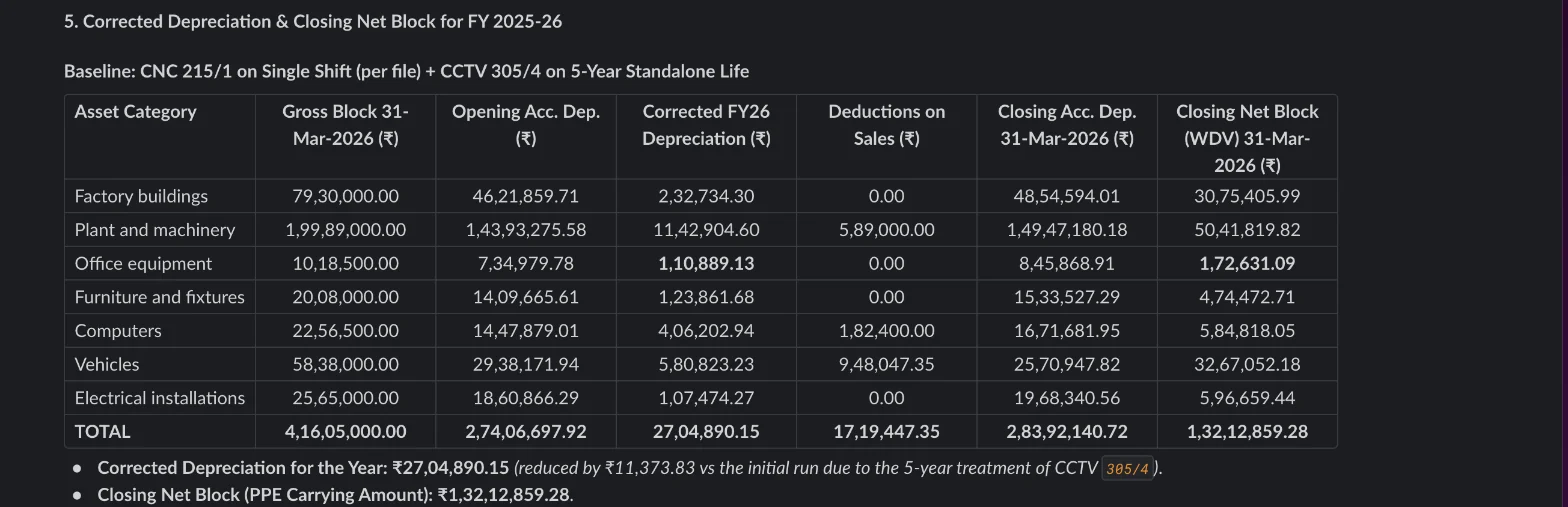
- Append the three sheets into one register and group it by category for the PPE schedule: opening cost, additions, disposals, closing cost, accumulated depreciation, net block and last year's net block. Tie each category's cost and accumulated depreciation to the trial balance.
Where it usually goes wrong
- A floor formula that gives a negative charge on an asset already below 5% of cost.
- A blank shift column on a machine, treated as single shift without asking.
- Freight or installation in the ledger but left out of the register.
- The same invoice entered twice, or an asset put to use after 31 March.
- An addition linked to a parent code that isn't in the register.
- Measuring an addition's remaining life from 1 April instead of from the day it goes into use, so it outlives its parent.
How an AI agent does it from Slack
We gave the agent four files for a made-up company near Pune, Avani Precision Tools: the opening register of 42 assets with lives, shifts and the board's depreciation policy; the year's additions, new and to existing assets; the three sales; and the fixed-asset ledgers from the trial balance. Every company, name, tax number and amount in these files is made up. The agent works in Slack, where it shows up as Mnemio AI, because Accountant AI is built on Mnemio AI.
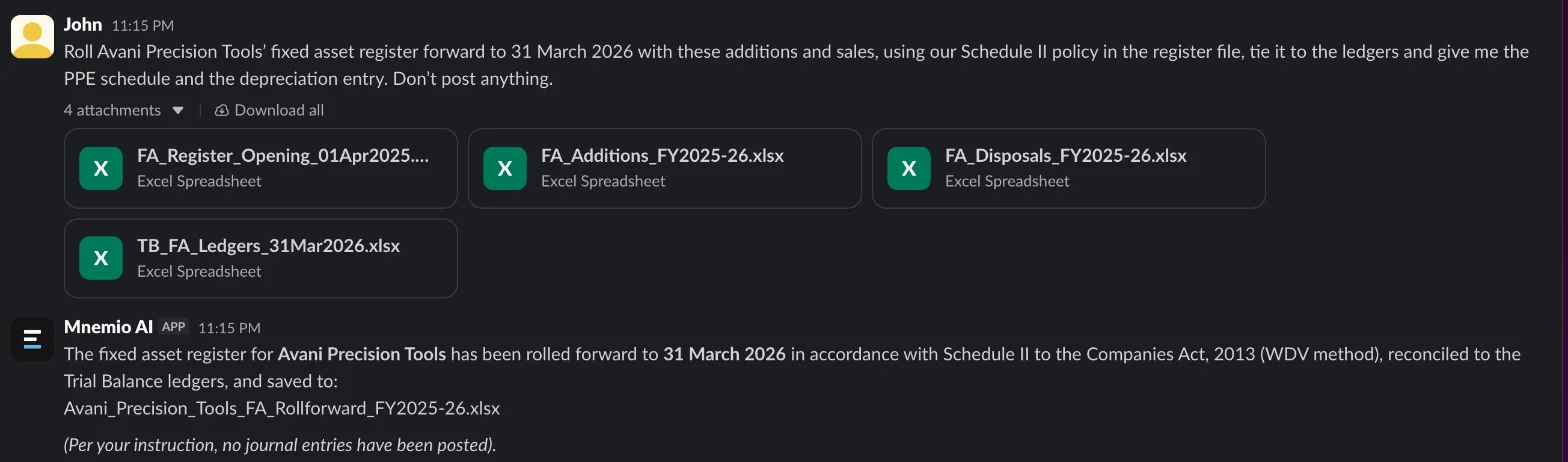
What the agent did
- Read the four files, rolled the 42 assets forward one by one and wrote a workbook.
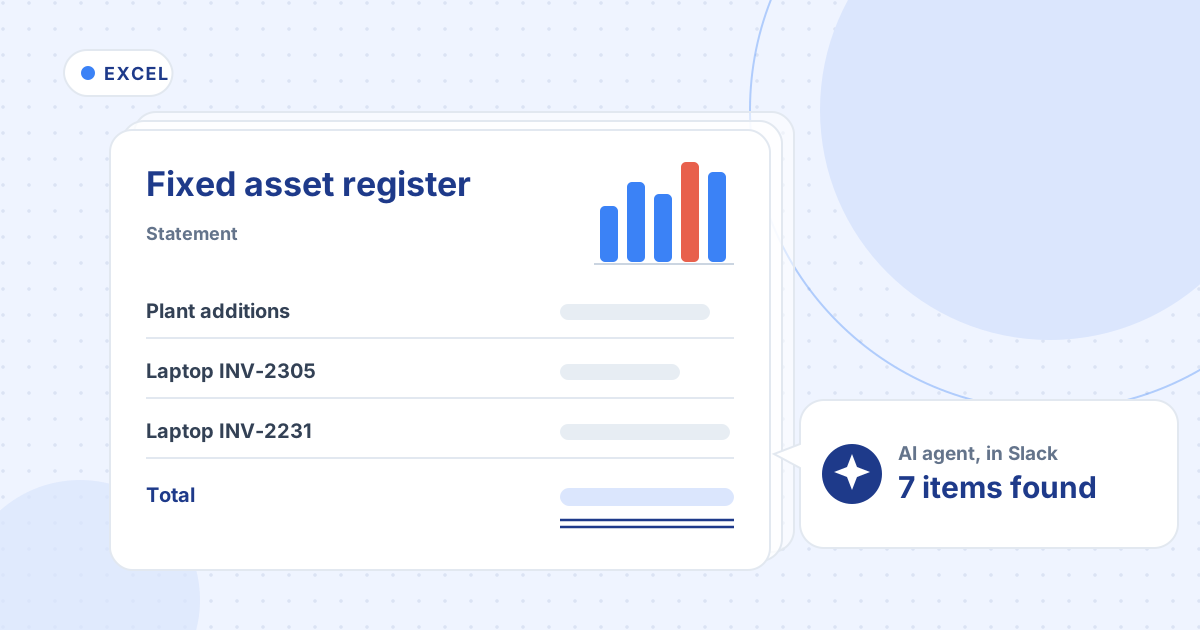
- Tied the additions to the ledgers: added ₹54,000 of freight to the machining centre's cost, and took out a laptop put to use on 2 April 2026 and a second entry of the same invoice.
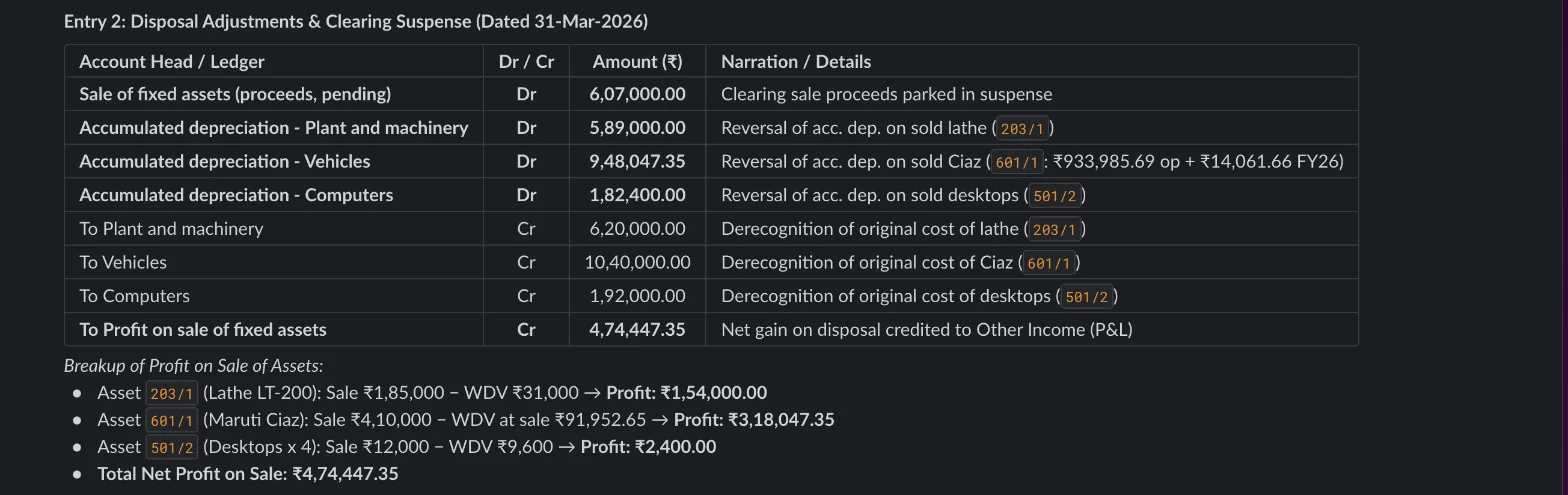
- Worked out the three sales (profit ₹4,74,447.35) and wrote the depreciation and disposal entries without posting them.
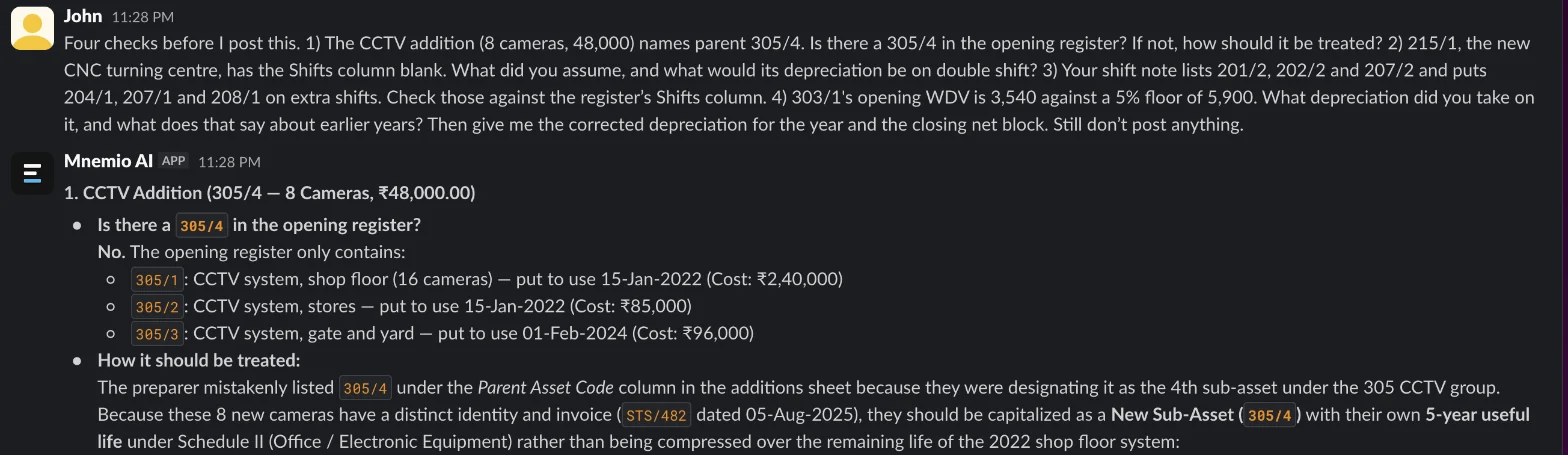
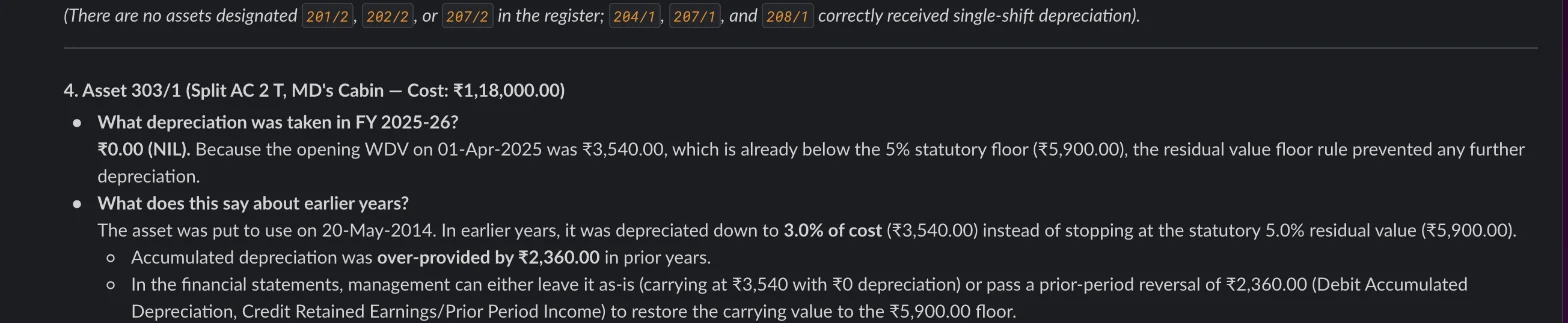
- Hung the CCTV cameras on a 305/4 that isn't in the register, didn't flag the machine with no shifts or 303/1, and listed the wrong codes in its shift note.
- When asked about those four rows, it treated the cameras as a new asset, said it had assumed single shift for 215/1 and gave a double-shift figure, put 303/1 at nil and corrected its note. Its total, ₹27,04,890.15, is ₹3,525 below ours because it measured remaining life from 1 April.
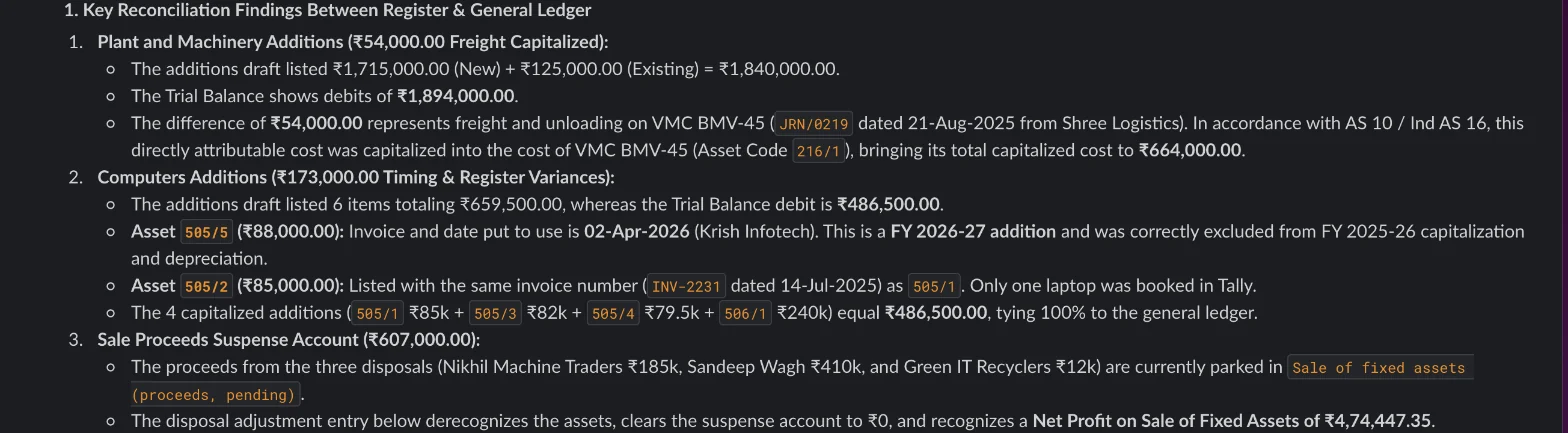
What it found
| Row | Problem | Fix |
|---|---|---|
| Plant additions | Register ₹18,40,000, ledger ₹18,94,000 | ₹54,000 freight added to 216/1 |
| Laptop INV-2305 | Put to use 2 April 2026 | Out: FY 2026-27 |
| Laptop INV-2231 | Entered twice | One removed |
| CCTV cameras, ₹48,000 | Parent 305/4 not in the register | New asset, 5 years; confirm |
| 215/1 CNC turning centre | Shifts blank | Single shift assumed; ask |
| 303/1 split AC | WDV ₹3,540, below the floor of ₹5,900 | Nil; earlier years ₹2,360 too much |
| Three sales | Proceeds in a holding ledger | Profit ₹4,74,447.35 |

What you still check
- 215/1's shifts, from the plant head. On double shift its charge rises from ₹1,00,199.86 to ₹1,50,299.79; the agent's figures for both were slightly off.
- Which asset the eight CCTV cameras belong to. The agent and we both treated them as a new asset; confirm with whoever made the entry.
- How you measure remaining life for additions to existing assets. We count from the day the addition goes into use; the agent counted from 1 April, which gives ₹3,525 less this year. Pick one and say so in the working.
- Whether to write back the ₹2,360 taken too much on 303/1 in earlier years. Agree the treatment with your auditor.
- Sale dates and proceeds against the sale documents.
Questions accountants ask
How do you work out the WDV rate under Schedule II?
Schedule II gives useful lives and limits residual value to 5% of cost; it doesn't give rates. The usual formula is rate = 1 − (residual ÷ cost)^(1 ÷ life), which gives 18.10% for 15 years, 25.89% for 10, 45.07% for 5 and 63.16% for 3.
How does extra shift depreciation work?
For plant and machinery used on double shift, depreciation for that period goes up by 50%; on triple shift, by 100%. Items Schedule II marks NESD (no extra shift depreciation) don't get it. Take the shifts from the plant head each year.
What if an asset's WDV is already below 5% of cost?
Charge nothing. A floor formula would give a negative figure; take nil and find out why earlier years took too much. Schedule II limits residual value to 5% of cost, and a company that uses a different figure has to disclose why.
Hand this job to an agent
Bring one of your own files to a 30-minute call and watch an agent do it.
Book a 30-min demo