Short answer: To reconcile GSTR-9 with your books, put the portal's system-computed GSTR-9 next to the same report from your books and compare each table: outward supplies (Table 4), reverse charge, the ITC split in Table 6, and 6A against 8A. Explain every difference before filing. An AI agent can do the comparison and list the questions for you.
GSTR-9 for FY 2025-26 is on every CA's desk this quarter. It is normally due on 31 December; check for any extension before you plan around that date.
Most of the work is a comparison of two spreadsheets, table by table. That is exactly the kind of work an agent does well, so below is the manual method from a recent tutorial and then the same job done by an agent.
The tutorial this is based on
GSTR9 FOR FY 25-26 | GST ANNUAL RETURN GSTR9 | GSTR9 FROM TALLYPRIME | GSTR9 VS BOOKS RECONCILIATION by Tally Home & Institute, published 30 October 2026 (in Hindi). It sets the portal's GSTR-9 next to TallyPrime's, then works through a pre-filing checklist.
How do you reconcile GSTR-9 with your books?
- Open GSTR-9 for FY 2025-26 in TallyPrime and export it to Excel.
- On the GST portal, download the system-computed GSTR-9 and open it in the offline utility so both versions are in Excel.
- Compare Table 4: B2C and B2B supplies, then reverse-charge supplies on which you paid tax.
- Compare the Table 6 ITC split into inputs, capital goods and input services.
- Compare Table 6A (ITC claimed in GSTR-3B) with Table 8A (ITC in GSTR-2B), and explain the gap supplier by supplier.
- Run the final checklist: GSTR-1 vs books, GSTR-3B vs books, IMS vs books and the GST ledgers, before you file.
Where it usually goes wrong
- Reverse-charge tax paid in GSTR-3B for some months but never booked in the books.
- An invoice in GSTR-2B that was never booked, so ITC was never claimed. Check the deadline before it lapses.
- Capital-goods ITC booked under inputs, which makes the Table 6 split wrong.
- A credit note issued after 31 March that relates to the year. It belongs in the amendment tables, not Table 4.
- Small rounding gaps hiding a real difference in the same supplier's total.
How an AI agent does it from Slack
We gave the agent two files for a made-up company, Navrang Packaging: one with what the portal shows (GSTR-3B for the year, GSTR-2B and the system-computed GSTR-9) and one with the books (Tally's GSTR-9 report, ITC by supplier and the credit notes). We planted five differences. Every company, name, tax number and amount in these files is made up. The agent works in Slack, where it shows up as Mnemio AI, because Accountant AI is built on Mnemio AI.
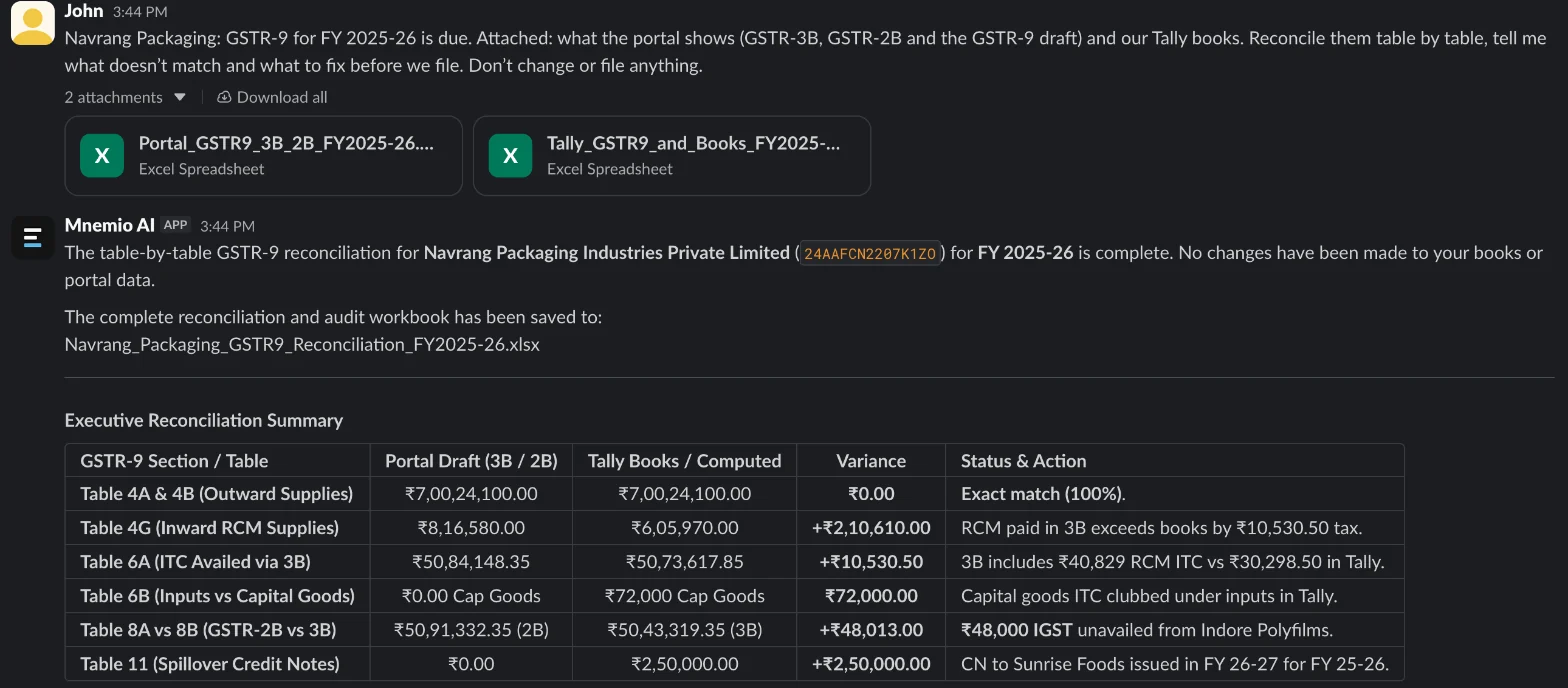
What the agent did
- Compared each GSTR-9 table in the portal draft with the same table from the books.
- Found ₹10,530.50 more reverse-charge tax paid in GSTR-3B than recorded in Tally, and gave the two likely reasons: freight bills never booked, or tax over-declared in 3B.
- Matched GSTR-2B to the books supplier by supplier to explain the 6A vs 8A gap.
- Checked the Table 6 split and found capital goods sitting under inputs.
- Picked out the credit note issued in May 2026 that relates to FY 2025-26.
- Listed what to fix, what to report where, and the decisions for the CA.
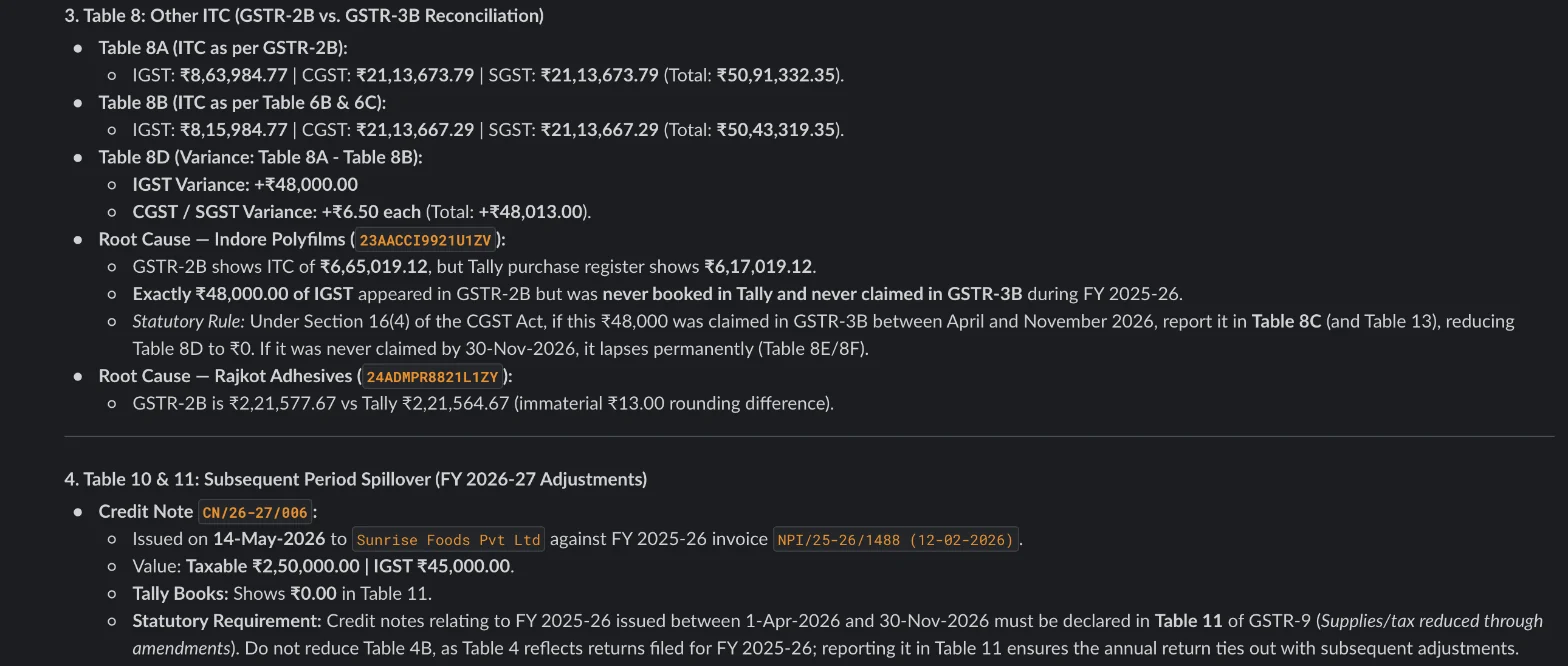
What it found
| Table | Portal / 2B (₹) | Books (₹) | Why |
|---|---|---|---|
| 4G reverse charge (tax) | 40,829.00 | 30,298.50 | 10,530.50 more paid in 3B than booked: freight bills missing in Tally, or over-declared |
| 6A vs 8A | 8A higher by 48,013.00 | An Indore Polyfilms invoice (IGST 48,000) never booked, plus 13.00 rounding | |
| 6B split | 72,000.00 under inputs | IGST on a machine booked as inputs; move it to capital goods | |
| Table 11 | Credit note CN/26-27/006 (taxable 2,50,000, IGST 45,000) relates to FY 2025-26 | ||
| 4A and 4B | Same | Same | No difference |
What you still check
- Whether the unbooked ₹48,000 ITC can still be claimed. Under the rules it generally has to be claimed by 30 November 2026; confirm the date and the client's position.
- Where the credit note goes in the return, with the CA's judgement on the amendment tables.
- Whether the extra reverse-charge tax is unbooked freight or an over-declaration in 3B. The agent gives both possibilities; your records decide.
Questions accountants ask
What is the difference between Table 6A and 8A?
6A is the ITC you claimed in GSTR-3B for the year. 8A is the ITC your suppliers reported, as shown in GSTR-2B. A gap usually means invoices you never booked, invoices booked late, or rounding.
Does the agent file GSTR-9?
No. It prepares the comparison and the list of fixes. You review it and file it yourself on the portal.
Can it do this for many clients?
Yes. Give it each client's files, or a folder per client, and it works through them one by one, so the review time goes to the differences instead of the copying.
Hand this job to an agent
Bring one of your own files to a 30-minute call and watch an agent do it.
Book a 30-min demo