Short answer: Reverse charge applies to set services, such as an advocate's fees, transport by a goods transport agency, security from a non-company, commercial rent from an unregistered landlord and directors' fees. For each bill, raise both the tax and the input credit by a journal, pay the tax in cash, and report it in 3.1(d) and 4(A)(3) of GSTR-3B. An AI agent can check a month of expenses and list the fixes before you pay.
Reverse charge is easy to miss because the bill has no GST on it. The service and the type of supplier decide whether you owe the tax, not the bill.
Here is the three-step method from a recent tutorial, then an agent checking a food company's August expenses against its RCM journals, the draft GSTR-3B and the cash paid, and the follow-up it needed.
The tutorial this is based on
RCM Entry in Tally Prime with Example | Reverse Charge Mechanism Accounting in Tally Prime | GST RCM by CA. Shweta Jain, published 31 August 2026 (in Hindi). A short TallyPrime walk-through with one advocate's bill: the ledger set-up, the adjustment journal and the payment. We took the steps from it; the GSTR-3B table numbers and the list of RCM services are ours, checked against Notification 13/2017-CT(R).
How do you pass RCM entries in TallyPrime?
- Book the bill as a purchase in accounting-invoice mode, to a ledger for the service with GST, the SAC and the rate, and "applicable for reverse charge" set to Yes. If the field is missing, turn on reverse charge in F12.
- Enter the bill without GST. The tax analysis shows the GST as subject to reverse charge.
- In the GSTR-3B report, the bill shows under inward supplies liable to reverse charge (Table 3.1(d)) and again as input credit (Table 4(A)(3)).
- Open Reverse Charge Supplies under Other Reports to see the tax still to be booked.
- Pass a journal with the stat adjustment "increase of tax liability and ITC": debit input CGST and SGST (or IGST) and credit output CGST and SGST (or IGST). The balance to be booked falls to zero.
- Pay the tax in cash. Reverse charge can't be paid from the credit ledger. Once it is paid, the input credit is usable.
- Before you pay, check each bill: is the service on the reverse charge list, what type of supplier is it, and is the supplier in another state (IGST)?
Where it usually goes wrong
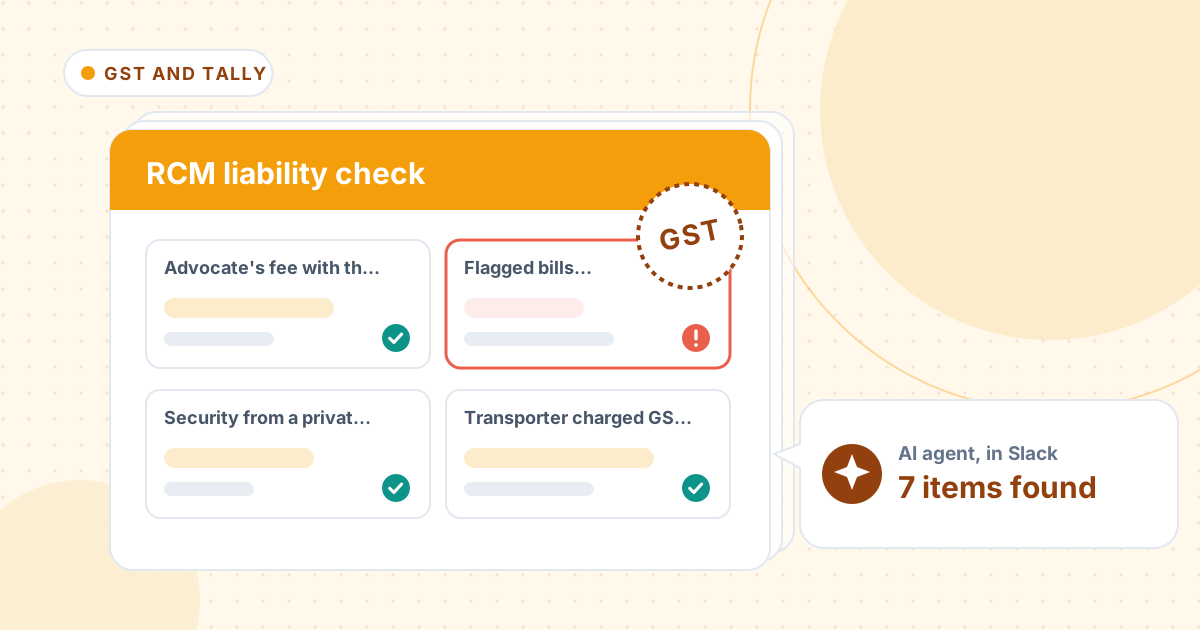
- An advocate's fee booked under professional fees with the reverse charge flag off.
- A transporter that charges GST on its bill still flagged as reverse charge.
- Security from a private limited company flagged as reverse charge. Only security from a non-company is.
- A flagged bill with no adjustment journal, so the cash paid falls short.
- An out-of-state supplier booked as CGST and SGST because its ledger has the wrong state.
- Paying reverse charge from the credit ledger.
How an AI agent does it from Slack
We gave the agent four files for a made-up Lucknow food company, Gomti Fresh Foods: August's expense ledger from Tally, the party master, the RCM journals passed and the draft GSTR-3B with the cash deposited. Every company, name, tax number and amount in these files is made up. The agent works in Slack, where it shows up as Mnemio AI, because Accountant AI is built on Mnemio AI.

What the agent did
- Checked August's expense vouchers against the RCM journals, the draft GSTR-3B and the cash deposited, and saved the register and the corrected figures as a workbook.
- Found two flagged bills with no journal, ₹22,500 of tax, which is why the cash paid didn't match Tally's draft.
- Found an advocate's ₹60,000 fee with the flag off (₹10,800 of RCM missed), and two bills wrongly under RCM: a private limited security agency (₹12,960) and a transporter that charged GST on its bill (₹1,500).
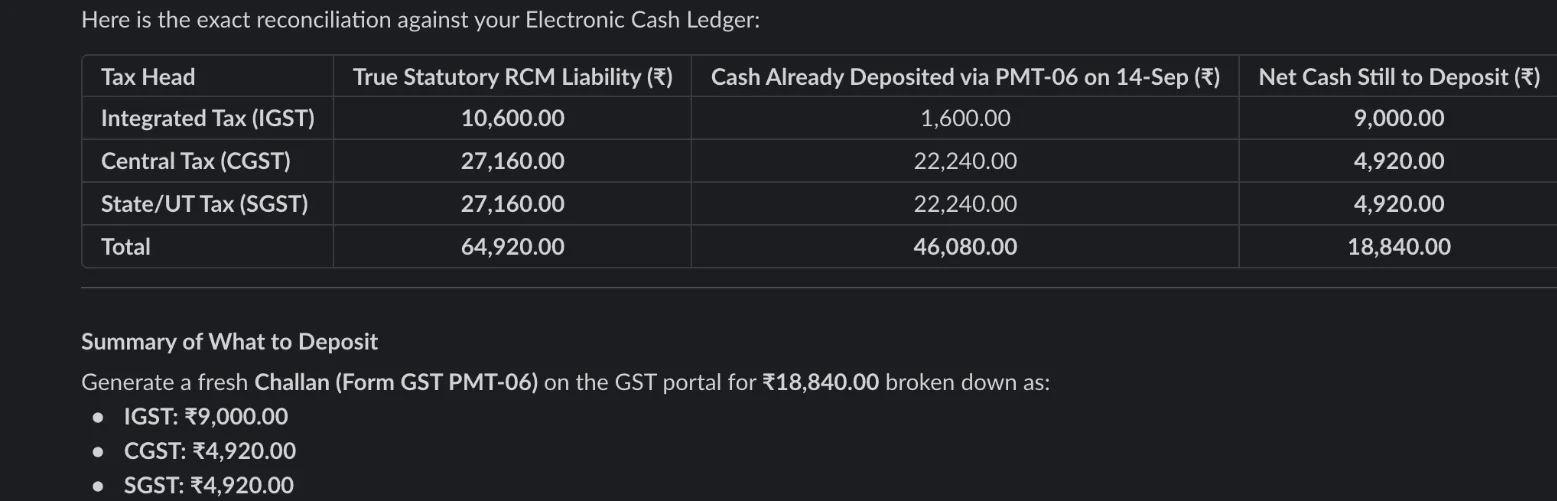
- Put the correct reverse charge at ₹64,920 on ₹4,43,000 and the cash still to pay at ₹18,840, and said it must be paid in cash.
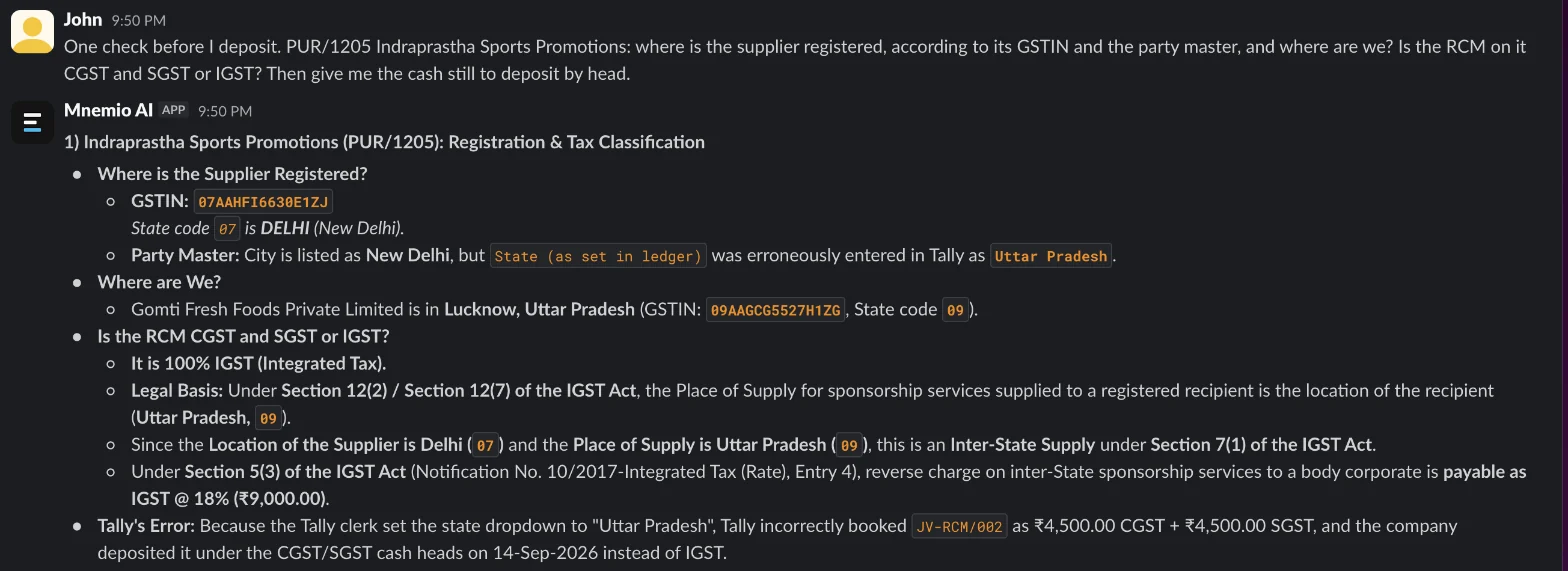
- Got the tax head wrong on one bill: it kept a Delhi sponsor's ₹9,000 as CGST and SGST, so its cash by head was wrong.
- Asked where the sponsor is registered, it moved the ₹9,000 to IGST and gave the cash by head: IGST ₹9,000, CGST ₹4,920 and SGST ₹4,920.

What it found
| Problem | Bill | Tax (₹) | Fix |
|---|---|---|---|
| Advocate's fee with the flag off | PUR/1230 | 10,800.00 | Set the flag; pass the RCM journal |
| Flagged bills with no journal | PUR/1187, PUR/1209 | 22,500.00 | Pass the RCM journals |
| Security from a private limited company | PUR/1244 | 12,960.00 | Not RCM; reverse the journal |
| Transporter charged GST on its bill | PUR/1217 | 1,500.00 | Not RCM; reverse the journal and claim its GST as normal ITC |
| Delhi sponsor booked as CGST and SGST | PUR/1205 | 9,000.00 | IGST |
| Correct reverse charge for August | 11 bills | 64,920.00 | 3.1(d) and 4(A)(3) |
| Cash still to deposit | 18,840.00 | IGST 9,000, CGST 4,920, SGST 4,920 |


What you still check
- Each supplier's type in the party master. Whether reverse charge applies depends on it.
- A tax invoice from the security agency charging GST, so you can claim that credit through 2B.
- Self-invoices for the reverse charge bills from unregistered suppliers, within 30 days. The agent didn't mention them.
- The Delhi sponsor's ledger state, so its next bill lands in IGST.
- The challan and the journals, which you create and post yourself.
Questions accountants ask
Can I pay RCM from my input tax credit?
No. Reverse charge has to be paid in cash. The credit it creates in 4(A)(3) can be used once the tax is paid.
Where does RCM go in GSTR-3B?
The tax goes in Table 3.1(d), inward supplies liable to reverse charge, and the same amount as input credit in Table 4(A)(3).
Does the agent post the journals or pay?
No. It lists the bills and gives the journal lines and the cash by head. You post the journals and pay the challan yourself. It asks before it changes or submits anything.
Hand this job to an agent
Bring one of your own files to a 30-minute call and watch an agent do it.
Book a 30-min demo