Short answer: Reverse blocked credit, such as car insurance or a personal purchase, for good in 4(B)(1) of GSTR-3B. Reverse credit you can get back, such as a bill unpaid after 180 days (Rule 37) or a supplier that didn't file GSTR-3B by 30 September (Rule 37A), in 4(B)(2), and reclaim it in 4(A)(5) and 4(D)(1) once you pay or the supplier files. An AI agent can build the register and journals, but check personal purchases yourself.
Credit you have to reverse rarely announces itself. It sits in the purchase register as an ordinary bill that 2B showed and you claimed, and only the narration, the payment date or the supplier's filing status gives it away.
Here is the method from a recent TallyPrime tutorial, then an agent building a forging company's October register from four exports, and the two follow-ups it needed.
The tutorial this is based on
ITC Reversal & Reclaim Entry in TallyPrime | Permanent vs Temporary Reversal by FinBookPro by Vivek Awasthi, published 13 November 2026 (in Hindi). A joint upload with FinTaxPro. It works a car insurance bill and a Rule 37A case from the journal to the reclaim. Rule 37, a bill unpaid after 180 days, is one of Tally's options but isn't worked in the video; the demo below adds it. We checked the table numbers against Circular 170/02/2022-GST.
How do you pass an ITC reversal entry in TallyPrime?
- Sort each reversal. Permanent: credit blocked under section 17(5), such as car insurance, or goods for personal use. Temporary: credit you can reclaim, such as a bill unpaid 180 days after its date (Rule 37) or a supplier that didn't file its GSTR-3B by 30 September after the year (Rule 37A).
- For a permanent reversal, open a journal (F7), press Alt+J and choose the stat adjustment "Reversal of input tax credit" with "Ineligible credit". Debit the expense (or the asset) and credit input IGST, or CGST and SGST. Date it the same as the bill. GSTR-3B shows the credit in 4(A)(5) and reverses it in 4(B)(1).
- For Rule 37A, check each supplier's return filing status on the portal (Search Taxpayer). If a bill's GSTR-1 is filed but its GSTR-3B isn't by 30 September, reverse the credit in a return filed by 30 November. Then there is no interest.
- Pass the temporary reversal with "Others" (the video's TallyPrime has no Rule 37A option). Debit a ledger such as "ITC reversal & reclaim - temp" under Current Assets and credit the input taxes. It shows in 4(B)(2). The wrong option sends it to the wrong table.
- For Rule 37, list the bills still unpaid 180 days after their date. Reverse the credit in the next return with "Non-payment to supplier", and pay interest under section 50.
- When the supplier files or you pay the bill, reclaim: debit the input taxes and credit the temp ledger. The reclaim must show in 4(D)(1). The video uses the Rule 37 option for this because "Others" doesn't put it there, and says that head is technically wrong.
- Keep a register of every reversal: invoice, rule, permanent or temporary, table, month reversed, interest and month reclaimed. The section 16(4) time limit doesn't apply to a reclaim (rule 37(4)).
Where it usually goes wrong
- Car insurance or car repairs claimed in full. Repairs to a goods carrier are not blocked.
- A personal purchase booked to an office ledger, where only the narration gives it away.
- A supplier that filed GSTR-1 but not GSTR-3B. Your 2B still shows the credit.
- Bills nobody tracks past 180 days unpaid.
- A temporary reversal put in 4(B)(1), which leaves nothing in the reversal statement to reclaim against later.
- A reclaim that isn't reported in 4(D)(1).
How an AI agent does it from Slack
We gave the agent four files for a made-up Rajkot forging company, Avirat Forgings: the purchase register for January to October 2026 with the month each credit was claimed, the supplier payments, the suppliers' return filing status and the reversal register so far. Every company, name, tax number and amount in these files is made up. The agent works in Slack, where it shows up as Mnemio AI, because Accountant AI is built on Mnemio AI.
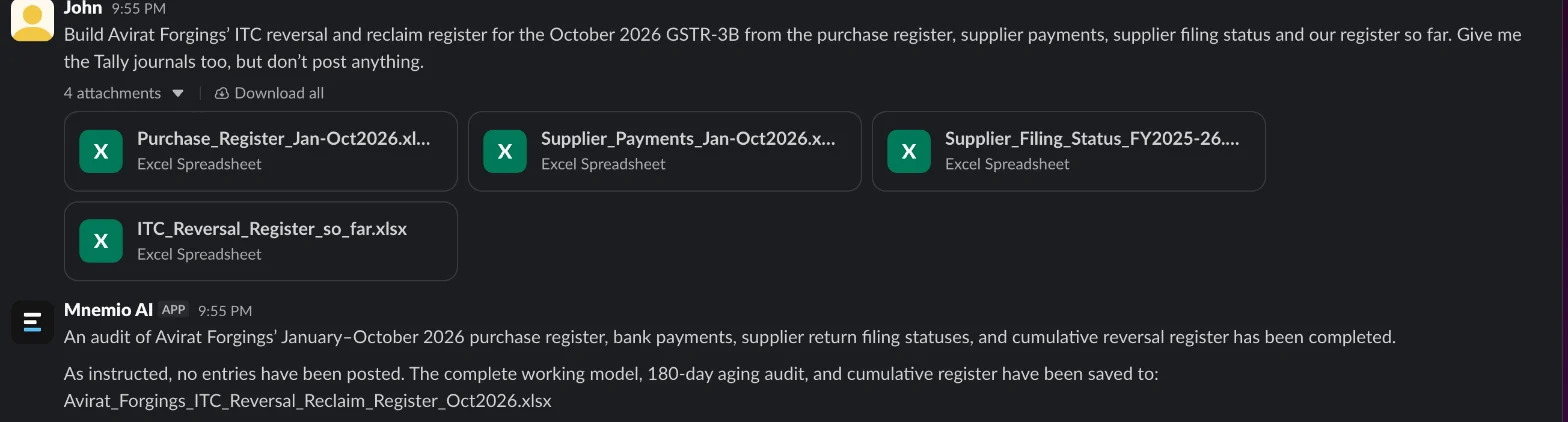
What the agent did
- Checked the purchase register against the payments, the suppliers' filing status and the register so far, and saved the register and the bill-wise ageing as a workbook. It posted nothing.
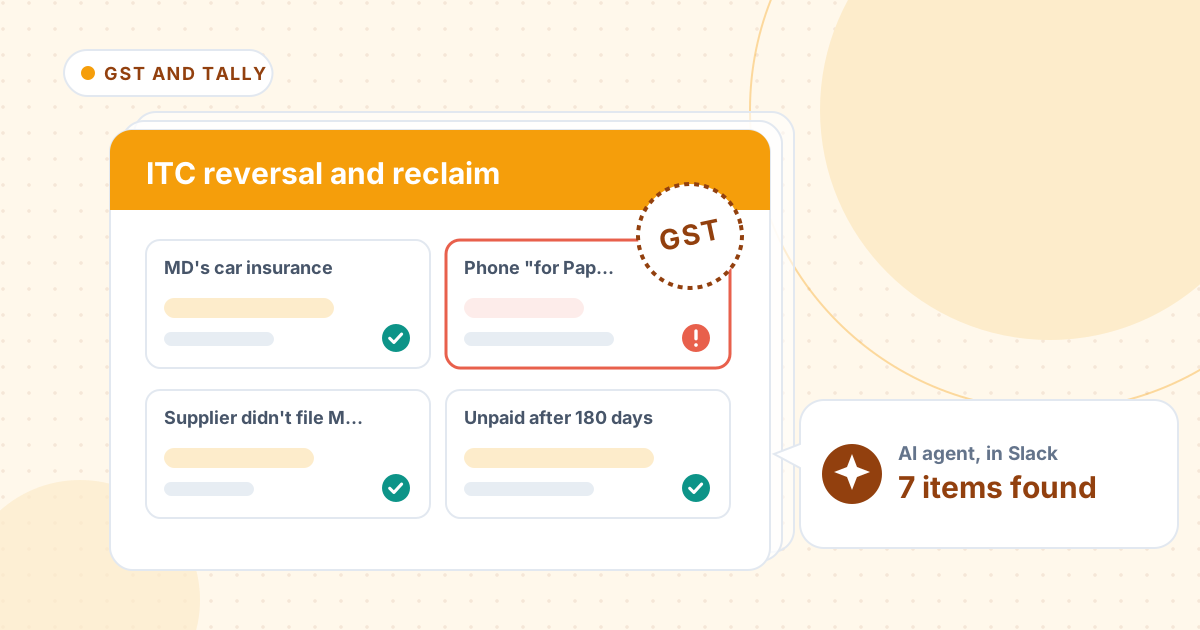
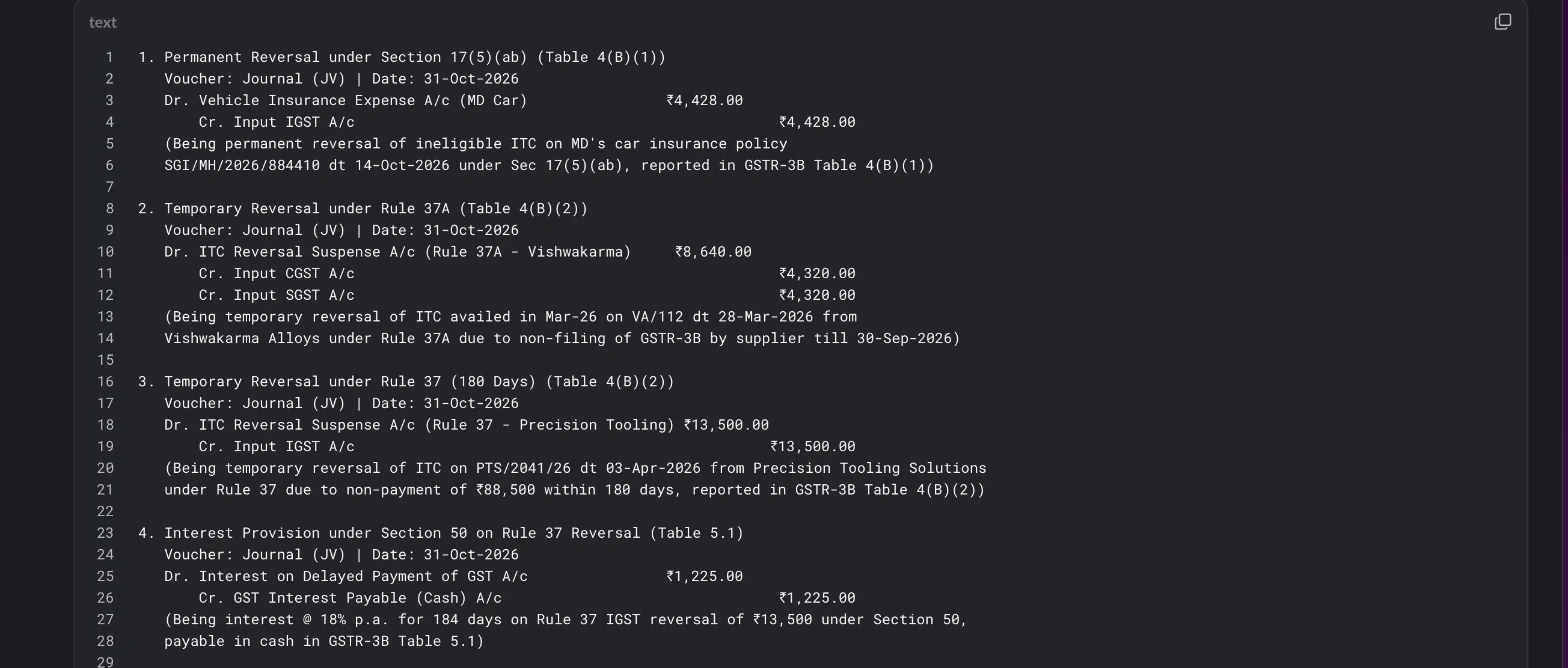
- Reversed the MD's car insurance (₹4,428) for good under section 17(5)(ab), in 4(B)(1).
- Found a tooling bill still unpaid 180 days after 3 April (₹13,500, Rule 37) and a supplier that filed its March GSTR-1 but not its GSTR-3B (₹8,640, Rule 37A), both for 4(B)(2), with ₹1,225 of interest on the first and none on the second.
- Reclaimed ₹9,720 on a bill reversed in August and paid on 22 October, in 4(A)(5) and 4(D)(1), and worked out the statement balance at ₹31,050.
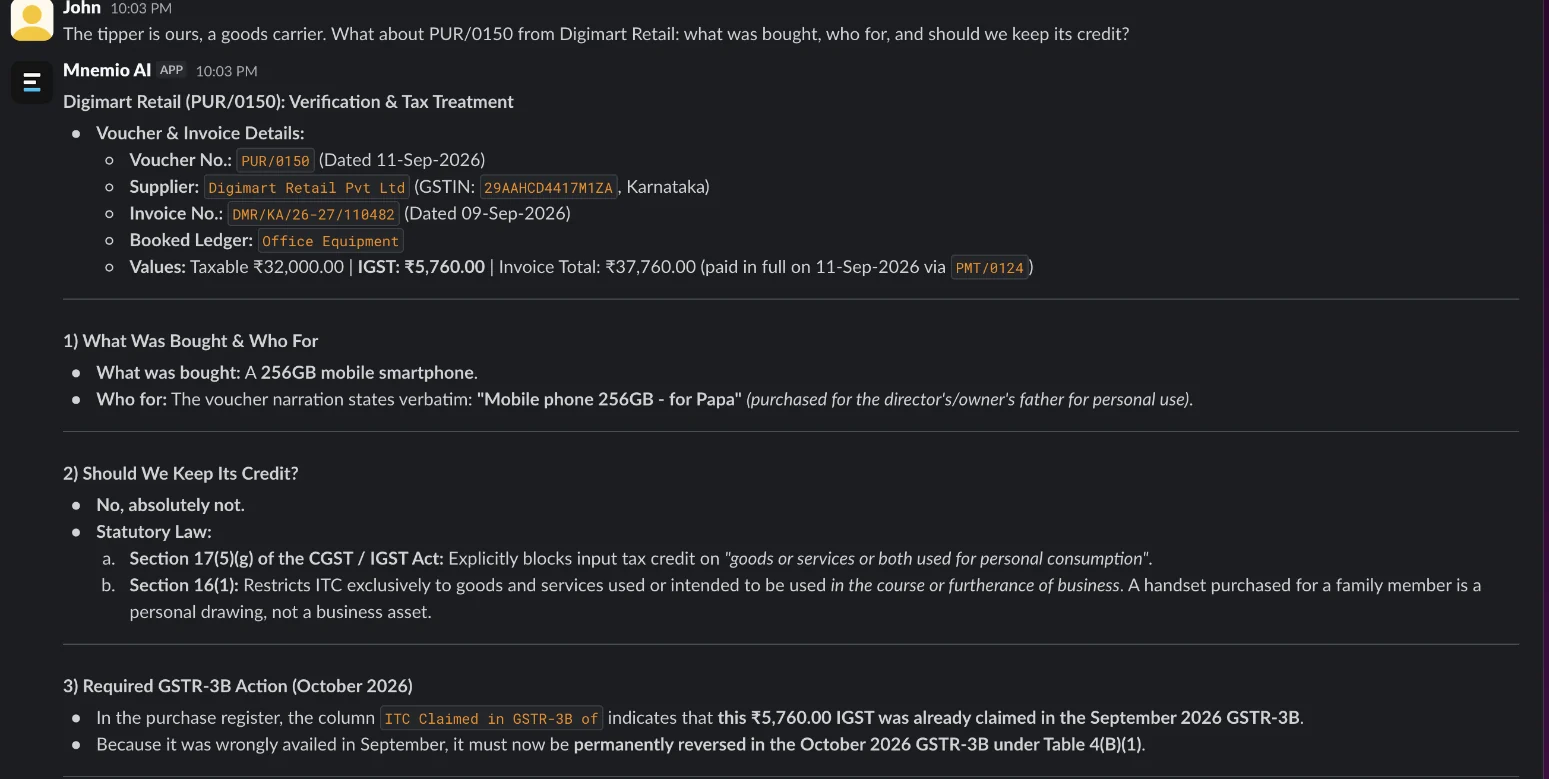
- Missed a ₹5,760 phone booked to office equipment with the narration "for Papa". Asked which bills to confirm with the owner, it named a tipper repair (a goods carrier, so not blocked) and missed the phone again. It confirmed GIR Machine Tools filed in time.
- Asked about the phone's bill by number, it reversed the credit under section 17(5)(g) and put 4(B)(1) at ₹10,188. It assumed personal use instead of asking, and said nothing about interest on the September claim.

What it found
| Item | Bill | Tax (₹) | Treatment |
|---|---|---|---|
| MD's car insurance | SGI/MH/2026/884410 | 4,428.00 | Blocked, 17(5)(ab): 4(B)(1) |
| Phone "for Papa" (found when asked) | DMR/KA/26-27/110482 | 5,760.00 | If personal, 17(5)(g): 4(B)(1) |
| Supplier didn't file March GSTR-3B | VA/112 | 8,640.00 | Rule 37A: 4(B)(2), no interest |
| Unpaid after 180 days | PTS/2041/26 | 13,500.00 | Rule 37: 4(B)(2), interest about 1,225 |
| Bill paid on 22 October | SR/0577 | 9,720.00 | Reclaim: 4(A)(5) and 4(D)(1) |
| Supplier filed on 25 September | GIR Machine Tools | Nothing to reverse | |
| Reversal statement after October | 31,050.00 | 18,630 + 22,140 - 9,720 |



What you still check
- Every bill on office equipment, gifts, food or vehicle ledgers, and any narration that sounds personal. The agent missed the phone until asked about the bill.
- With the owner, whether the phone is for personal use. If so, interest on the September claim if the credit was used.
- The phone's journal: a company has no drawings account, so debit the director's account.
- The interest on the Rule 37 reversal. The start date and the sub-section of section 50 are debated, so confirm it with your CA.
- Each supplier's filing status on the portal on the day you file, and the stat adjustment option on each journal. You post the journals and file yourself.
Questions accountants ask
What goes in 4(B)(1) and what goes in 4(B)(2)?
4(B)(1) is for credit you can't get back: blocked credit under section 17(5) and reversals under rules 38, 42 and 43. 4(B)(2) is for credit you may reclaim, such as Rule 37 and Rule 37A reversals. When you reclaim, report it in 4(A)(5) and 4(D)(1).
Is interest payable on a Rule 37A reversal?
Not if you reverse it in a return filed by 30 November after the year ends. After that, interest under section 50 applies. You reclaim the credit when the supplier files its GSTR-3B.
Does the agent post the journals or file the return?
No. It builds the register and gives the journal lines and the 3B figures. You post the journals and file yourself. It asks before it changes or submits anything.
Hand this job to an agent
Bring one of your own files to a 30-minute call and watch an agent do it.
Book a 30-min demo