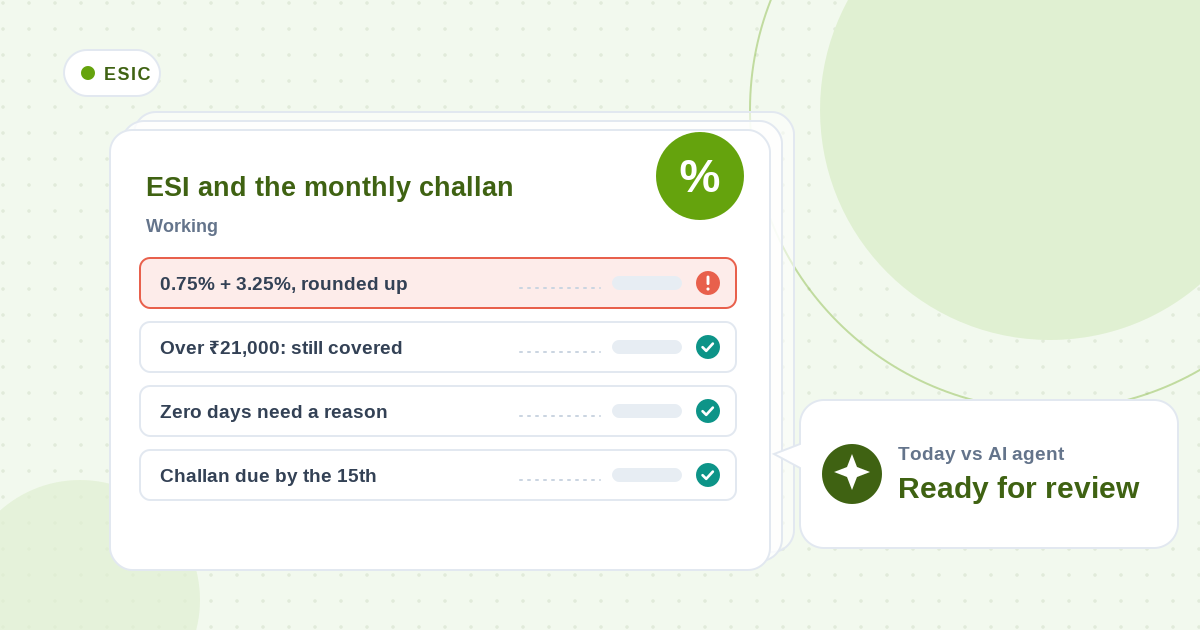
Short answer: The ESI challan is due by the 15th of the following month. The employee pays 0.75% and the employer 3.25% of the month's wages, each rounded up to the next rupee for every employee. The coverage ceiling now applied is ₹21,000 a month. Late payment costs 12% a year simple interest plus damages. Whether wages means Code wages or gross is still open.
ESI goes wrong in two places. The calculation: the Code on Social Security changed the meaning of wages from 21 November 2025, and ESIC hasn't said which base it expects. And the monthly filing, where a wrong month or a missing reason is hard to undo. The rates are settled by the Social Security (Central) Rules 2026.
This post follows a two-part Hindi tutorial: the wage calculation in Part 1, and the member check and upload in Part 2. It adds the due date, interest and damages, and a worked December 2026 example. Then it explains how an AI agent would prepare the month's file, and what you still do on the portal.
The tutorial this is based on
ESIC Wage Calculation Under New Labour Codes 2026 | Salary Examples + Excel Demo | Part 1 by Statutory Solution, published 31 October 2026 (in Hindi). It separates what is settled from what is still open, works two salaries both on gross and on Code wages, and explains the contribution periods. One point is out of date: it says no rates have been notified under the Code, but rule 19 of the Social Security (Central) Rules 2026, notified on 8 May 2026, sets 3.25% and 0.75%. In its second example the employee share is ₹83 (₹82.50 rounded up); the auto-captions show a different figure. For the filing we followed the same channel's Part 2, on making the ESIC challan (1 November 2026, in Hindi), which matches the portal's member list to the register and uploads the file, with the menu path from ESIC's own e-Payment guide.
How do you work out ESI and pay the ESI challan?
- Check coverage: establishments with 10 or more persons, seasonal factories aside, in areas where ESI benefits are provided. Register each new employee on the portal with Aadhaar before or on the day they join; the IP number lapses after 30 days if the declaration isn't completed.
- Find who is in. The ceiling now applied is ₹21,000 a month, or ₹25,000 for a person with disability, per the labour ministry FAQ and ESIC's coverage page. No fresh notification under the Code has set it yet, so check for one. Test wages at the start of each contribution period: 1 April to 30 September and 1 October to 31 March.
- Keep people covered after a raise. Someone whose wages cross the ceiling after the period has begun stays covered to 30 September or 31 March (S.O. 2351(E), 8 May 2026).
- Settle the wage base and write it down. The labour ministry says ESI is now on Code wages (s.2(88)), but ESIC has not issued its own instruction on the base, and employers differ. Decide your basis, record it, and check the latest ESIC circulars. The tutorial shows both practices: some teams still use gross, overtime included; others use Code wages, which leave out overtime and HRA (the 50% add-back is explained in the gratuity post).
- Work out the shares: 0.75% for the employee and 3.25% for the employer, each rounded up to the next rupee per employee. Part 1's first example gives ₹98 and ₹423 on Code wages of ₹13,000, against ₹154 and ₹667 on gross of ₹20,500.
- Apply the low-earner rule. ESIC's page still exempts employees earning up to ₹176 a day on average from the employee share (the employer still pays 3.25%); check what the portal computes.
- Check the data as Part 2 does: match the portal's active member list to the register, and look for IP numbers that aren't 10 digits, duplicates, zero days without a reason and fractional days.
- File: Employer Login, Monthly Contribution, File Monthly Contribution. Pick the month with care, because an uploaded contribution can't be rejected. Enter or upload days and wages per IP number, with a reason for anyone on zero days, preview, submit and pay the e-challan. Note the challan number.
- Pay by the 15th of the following month. Late payment carries 12% a year simple interest from the due date, and damages, capped at the arrears, of up to 5% a year for a delay under two months, 10% up to four, 15% up to six and 25% beyond.
ESI contribution rules for 2026-27
| Item | Rule |
|---|---|
| Employee share | 0.75% of wages, rounded up to the next rupee (rule 19) |
| Employer share | 3.25% of wages, rounded up to the next rupee (rule 19) |
| Coverage ceiling | ₹21,000 a month (₹25,000 with disability), as now applied; check for a fresh notification |
| Low earners | Up to ₹176 a day: no employee share; the employer still pays (ESIC page) |
| Wages | Code wages per the labour ministry; ESIC hasn't restated the base, so record yours |
| Contribution periods | April to September and October to March; a mid-period raise keeps cover to the period end |
| Due date | 15th of the following month (ESI (General) Regulations, reg. 31) |
| Late payment | 12% a year simple interest, plus damages of up to 5% to 25% a year |
A worked example: the December 2026 contribution
A made-up Ludhiana hosiery unit files on Code wages, the basis it has recorded. A machine operator earns ₹20,900 gross, including ₹2,500 of overtime. Excluded heads are ₹8,900, under half of pay, so ESI wages are ₹12,000 and the shares ₹90 and ₹390. On gross they would be ₹157 and ₹680.
A supervisor's raise from 1 December takes wages to ₹23,000. The period began on 1 October, so they stay covered to 31 March 2027: ₹172.50 and ₹747.50, rounded up to ₹173 and ₹748. A joiner from 10 December earned ₹9,000 for 22 days (₹68 and ₹293) but was never registered, so they need an IP number first. A part-time cleaner on ₹3,600 for 31 days averages ₹116.13 a day, so no employee share; the employer pays ₹117. A leaver and someone on leave go in with zero days and a reason.
ESI wages total ₹47,600 (gross ₹66,700 less ₹19,100 excluded). Employees pay ₹331 and the employer ₹1,548: a challan of ₹1,879, or ₹1,906 if the ₹176 rule were held not to apply. In the books, Cr ESI payable ₹331 from payroll and ₹1,548 for the employer's share, then Dr ESI payable ₹1,879, Cr Bank. Paid 46 days late on 2 March 2027, it would carry ₹28.42 of interest and up to ₹11.84 of damages.
Where it usually goes wrong
- Rounding the challan total instead of each employee's share. Part 2 shows a ₹12 difference against the portal from this.
- Dropping someone whose raise took them over ₹21,000 before the period ends, or marking anyone out of coverage outside April or October.
- Uploading against the wrong month.
- Zero days with no reason, or a leaver with no last working day.
- Working on gross, overtime included, and also adding back allowances, which counts the same pay twice.
- Reading ESIC's circular of 3 November 2026 as a rate change. It changes benefits, not contributions.
- Using a contractor's staff without proof of their ESI payments. The principal employer remains liable.
How an AI agent does it
An AI agent here has its own files, spreadsheets and a real web browser, and each person on the team reaches theirs from Slack, WhatsApp or a web app. On the ESIC portal you sign in yourself, in its browser window; it never asks for a password in chat, and it asks before it submits or pays anything. Here is how it would prepare a month's ESI contribution. It can be wrong, so the last sections say what you still check.
What you give it
- The month's payroll register with every pay head, payable days, IP numbers, joining and leaving dates, and the ESI that payroll deducted
- The active member list and last month's contribution history from the ESIC portal, which it can download after you sign in
- The ESI payable and ESI expense ledgers, and the bank entry for last month's challan
- Your basis note: Code wages or gross, and how you read the 50% rule
What it does
- Maps each pay head to included, excluded or add-back for your recorded basis, and works out ESI wages.
- Decides who is covered, keeping anyone who crossed ₹21,000 mid-period in until 30 September or 31 March.
- Works out both shares per employee, rounded up, and applies the ₹176 test.
- Matches the register to the portal member list and lists people on one but not the other.
- Builds the upload file, with a reason and last working day for anyone on zero days.
- Compares its employee share with payroll's deduction, and ties the challan to ESI payable.
- After you sign in, enters the contribution up to the preview and stops before submit. It can run on a set day each month.
What it hands back
- The upload-ready contribution file and the challan total
- A per-employee comparison of gross pay and ESI wages, with both shares
- A flag list: missing IP numbers, mid-period crossers, zero days without a reason, deduction mismatches
- Draft journal entries for the employer share and the payment, as import-ready Excel or XML for Tally
What it leaves to you
- Choose the wage basis. That decision, and the note recording it, stay with you.
- Register a new joiner, which needs their Aadhaar authentication on the portal.
- Submit the contribution or pay the challan.
- Post entries into Tally. Your team imports them after review.
Today vs with an AI agent
| Step | Today | With an AI agent |
|---|---|---|
| Gathering the inputs | You export the register and download the member list from the portal. | You give it the register; it downloads the member list after you sign in. |
| The working | A sheet of wages and both shares, on whichever base payroll uses. | It works out ESI wages per pay head on your recorded basis, and both shares per person. |
| The cross-checks | Headcount against last month, and the challan against payroll's deduction. | It matches register to portal list, payroll deduction to its share, and challan to ESI payable. |
| Exceptions | Found when the totals don't match payroll or the portal preview. | It lists missing IP numbers, mid-period crossers, zero days without a reason and mismatches. |
| The output | The contribution typed in or uploaded, and the challan paid. | An upload-ready file, the challan total and draft entries. You submit and pay. |
| The review | A senior checks the total and the headcount. | You check its flags, the coverage decisions and the month. |
| Who signs off | The employer submits and pays by the 15th. | The same. It stops before submit and never pays. |
What you still check
- The basis note and the pay-head mapping, especially overtime and HRA.
- The headcount: the register, the upload file and the portal list should agree.
- Each mid-period crosser, and any out-of-coverage entry outside April or October.
- The month selected on the portal, before you submit.
- The challan total against the credit to ESI payable, with the challan number and date recorded. The PF side of the same payroll goes through the PF ECR file.
Questions accountants ask
Is ESI calculated on basic or gross?
The labour ministry says Code wages, which is neither: basic, DA and retaining allowance, topped up where allowances are more than half of pay. ESIC hasn't restated this, so record the basis you use.
What is the ESI wage limit in 2026?
The ceiling now applied is ₹21,000 a month, or ₹25,000 for persons with disability. Check for a fresh notification under the Code.
What happens if salary crosses ₹21,000 in the middle of the period?
Contributions continue to the end of that period, 30 September or 31 March.
What is the due date for the ESI challan, and what if it's late?
The 15th of the following month. Late payment carries 12% a year simple interest, and ESIC may levy damages.
How do I pay the ESIC challan online?
Employer Login, Monthly Contribution, File Monthly Contribution; enter or upload the month, submit, and pay the e-challan. Keep the challan number.
Does the agent pay the ESI challan?
No. It prepares the file and fills the portal up to the preview after you sign in. You submit and pay.
Hand this job to an agent
Bring one of your own files to a 30-minute call and watch an agent do this job.
Book a 30-min demo