Short answer: Advance tax is due when the year's tax, after TDS and TCS, is ₹10,000 or more. For tax year 2026-27, pay 15% by 15 June, 45% by 15 September, 75% by 15 December 2026 and 100% by 15 March 2027. Shortfalls cost 3% at each of the first three dates and 1% in March (section 425), plus 1% a month from April if under 90% is paid (section 424).
Advance tax is an estimate made four times a year from books that are not closed. The arithmetic is simple. The work is in the estimate: the profit to date, what the rest of the year will bring, the TDS customers will deduct, and the instalments already paid. Most interest comes from an estimate nobody revisited after September.
This post follows a recent tutorial for the payment steps under the Income-tax Act 2025, adds the instalment table and the interest rules from the Act, and works an example for the 15 December 2026 instalment. Then it explains how an AI agent would prepare the same working, and what stays with you.
The tutorial this is based on
Advance Tax कैसे Pay करें Online? Tax Year 2026-27 New IT Act 2025 | How to pay Advance Tax 2026 by CA Guru Ji, published 5 June 2026 (in Hindi). The presenter estimates an individual's tax, takes off TDS and pays it on e-Pay Tax under the Income Tax Act 2025 option for tax year 2026-27. For the calculation and the interest examples we followed CA Shweta Verma's Advance Tax Complete Guide (14 March 2026, in Hindi), which already uses the new section numbers. We added the 12% and 36% relief she leaves out and a business example; her point that salaried people needn't pay holds only when TDS covers the whole tax.
How do you work out and pay advance tax?
- Check whether it applies. Under section 404 (it was 208), advance tax is payable when the year's tax, after TDS and TCS, is ₹10,000 or more. A salaried person whose TDS covers the whole tax pays none.
- Estimate the year's income at each due date: the books to date, what the rest of the year should bring, and income outside the books such as interest, rent and capital gains.
- Work out the tax on that income under the regime the assessee uses, with surcharge and cess, and take off the TDS and TCS expected for the year. The tutorial rounds the result to the nearest ₹10.
- Find the cumulative figure for the date under section 408 (it was 211) and take off what has already been paid. The difference is this instalment. Section 406 lets you revise the estimate up or down for later instalments.
- Presumptive taxpayers under section 58(2) (the old 44AD and 44ADA) pay the whole amount by 15 March, in one instalment.
- Pay on the e-filing portal. Open e-Pay Tax (it works before logging in too), choose Income Tax Act 2025 for tax year 2026-27, enter the PAN twice and the mobile number, and confirm the OTP.
- Choose the Income Tax/Corporation Tax tile, tax year 2026-27 and Advance Tax (minor head 100), and enter the amount. The challan is ITNS 280N. Pay by net banking, debit card, UPI, credit card or at a bank counter.
- Download the challan and note the BSR code, date and challan serial number. You need them for the return, and the payment should appear in Form 168 (it was 26AS).
Advance tax due dates and interest for tax year 2026-27
| Due date | Paid by then, at least | Interest on a shortfall |
|---|---|---|
| 15 June 2026 | 15% of the year's advance tax | 3% (section 425), none if 12% is paid |
| 15 September 2026 | 45% | 3%, none if 36% is paid |
| 15 December 2026 | 75% | 3% |
| 15 March 2027 | 100% | 1% |
| 15 March 2027, presumptive under section 58(2) | 100%, in one instalment | 1% |
| After 31 March 2027 | Under 90% of the assessed tax paid | 1% a month from 1 April 2027 (section 424) |
A worked example: the 15 December instalment
A made-up Indore wholesale firm works out its tax in late November 2026. Its books to October and its estimate for the rest of the year put the tax for 2026-27 at ₹9,40,000. Customers will deduct ₹40,000 of TDS, so advance tax for the year is ₹9,00,000. It paid ₹1,20,000 by 15 June and ₹2,40,000 by 15 September, ₹3,60,000 in all.
The cumulative targets are ₹1,35,000 (15%), ₹4,05,000 (45%), ₹6,75,000 (75%) and ₹9,00,000. The firm was short in June and September, but it had paid 13.3% by June and 40% by September, above the 12% and 36% floors, so section 425 charges nothing for either date. By 15 December it needs ₹6,75,000 paid in all: ₹6,75,000 less ₹3,60,000 is ₹3,15,000.
If it pays only ₹2,15,000 in December, it has paid ₹5,75,000 and is ₹1,00,000 short of 75%. Interest for December is 3% of ₹1,00,000: ₹3,000. Paying the remaining ₹3,25,000 by 15 March 2027 keeps it at that.
If it skips March too and pays the ₹3,25,000 as self-assessment tax on 20 July 2027, the advance tax paid (₹5,75,000) is under 90% of ₹9,00,000. Section 424 adds 1% a month on ₹3,25,000 for April to July, four months counting July's part month: ₹13,000. Section 425 adds 1% on the March shortfall: ₹3,250. Interest comes to ₹19,250 instead of ₹3,000. These figures assume the return shows the same ₹9,00,000.
Where it usually goes wrong
- Working from last year's tax, so a good year leaves a large shortfall in December.
- Taking off TDS that customers haven't deducted or reported, so it never shows in Form 168.
- Forgetting income outside the books, such as a capital gain on shares. A gain that arises later can be paid with a later instalment, or by 31 March, without section 425 interest.
- Choosing the Income Tax Act 1961 option on e-Pay Tax for a 2026-27 payment. That option is for earlier years.
- The wrong minor head on the challan: Self Assessment Tax (300) instead of Advance Tax (100).
- Assuming a presumptive taxpayer under section 58(2) has June to December instalments. They pay it all by 15 March, and 1% applies to any shortfall then.
How an AI agent does it
Each person on the team gets their own AI agent, used from Slack, WhatsApp or a web app. It has its own files, spreadsheets and a real web browser: it reads the Excel, CSV, PDF and Tally exports you give it and writes its working in Excel. On a portal you sign in yourself, in its browser window, with your own password and OTP. It asks before it changes, sends, files or pays anything, and every step is logged. This section describes how it would prepare the advance tax working for a client. It can be wrong, so the last sections say what you still check.
What you give it
- The trial balance and profit and loss to date, exported from Tally or your books in Excel
- Last year's tax computation, or the regime and rates you used
- Form 168 (it was 26AS) and the e-Pay Tax payment history, which it can download in its browser after you sign in
- Your estimate for the rest of the year: a budget, expected large orders, any asset or share sales
What it does
- Projects the year's income from the books to date and your estimate for the rest, and lists each assumption on its own sheet so you can change it.
- Works out the tax under the regime in last year's computation, and takes off TDS, flagging any TDS in the books that hasn't reached Form 168.
- Applies the section 408 table: the cumulative figure for 15 December, less the challans already paid, gives the amount due.
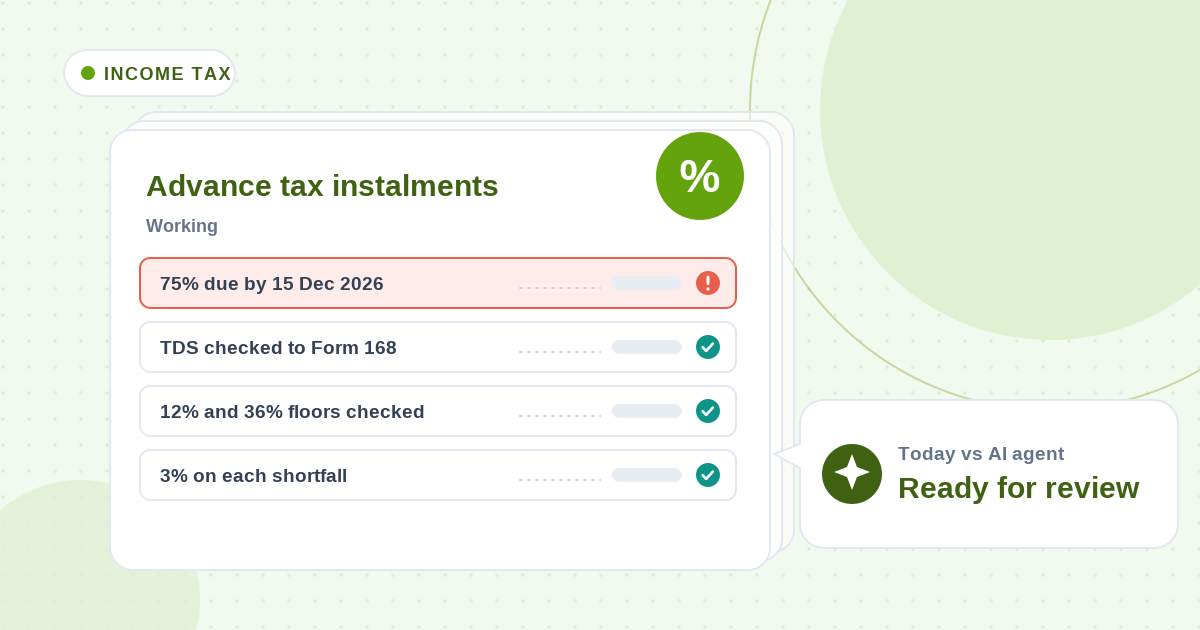
- Checks the June and September payments against the 12% and 36% floors and works out the section 425 interest each date would carry if the estimate holds.
- Flags income that section 425(4) treats differently, such as a capital gain or dividend that arose after an earlier due date.
- Fills the ITNS 280N challan on e-Pay Tax in its browser after you sign in, up to the payment step, and stops.
- Runs on a schedule if you ask, for example on 1 December and 1 March, and keeps each client's regime and estimates in the firm's shared memory.
What it hands back
- An advance tax workbook: the income estimate, the tax, TDS, the instalments paid and the amount due by 15 December
- The interest for June, September and December under section 425, and what skipping March would cost under section 424
- A list of points to confirm: TDS missing from Form 168, one-off income, the regime
- A draft message to the client with the amount, the date and the challan details
What it leaves to you
- Pay the challan. You choose the payment mode and pay it yourself.
- Decide the estimate. How much of a large order lands before March is your call.
- Choose the tax regime or the rates.
- Send the message to the client without asking.
Today vs with an AI agent
| Step | Today | With an AI agent |
|---|---|---|
| Gathering the inputs | You export the books, open Form 168 and the payment history, and ask the client about the rest of the year. | You give it the exports and the client's estimate. It downloads Form 168 after you sign in. |
| The working | An Excel sheet: estimated income, tax, TDS, the 75% figure, less what has been paid. | It builds the same sheet, with each assumption on its own sheet. |
| The cross-checks | TDS in the books against Form 168, and the challans against the payment history. | It matches TDS in the books to Form 168 and every challan to the payment history, line by line. |
| Exceptions | Spotted if someone notices missing TDS or a one-off gain. | It lists TDS missing from Form 168, income outside the books, and payments below the 12% and 36% floors. |
| The output | The amount due and a message to the client. | A workbook with the amount due, the interest for each date, and a draft message to the client. |
| The review | A senior checks the estimate and the arithmetic. | You check its assumptions and the estimate. The arithmetic is laid out row by row. |
| Who signs off | The accountant or the client approves the amount and pays. | You approve the amount and pay. It stops before the payment step. |
What you still check
- The estimate itself: orders, costs and one-off income for December to March. The agent projects only from what it is given.
- The regime and rates it used, against last year's return.
- TDS it took off that hasn't reached Form 168. If a customer never files their return, that credit may not come.
- Whether a late capital gain or dividend qualifies for the section 425(4) relief.
- The challan before you pay: tax year 2026-27, the Income Tax Act 2025 option, minor head 100 and the right PAN.
Questions accountants ask
What are the advance tax due dates for 2026-27?
15 June 2026 (15%), 15 September 2026 (45%), 15 December 2026 (75%) and 15 March 2027 (100%), all cumulative. Presumptive taxpayers under section 58(2) pay it all by 15 March 2027. Anything paid by 31 March counts as advance tax.
What is 234C interest called now?
Section 234C is section 425 of the Income-tax Act 2025. It charges 3% on the shortfall at 15 June, 15 September and 15 December, and 1% at 15 March, measured against the tax on the returned income. Nothing is charged for June if 12% was paid, or for September if 36% was paid.
What does section 424 (old 234B) charge?
If the advance tax paid is less than 90% of the assessed tax, 1% a month or part of a month on the shortfall, from 1 April after the tax year until the tax is paid or the income is determined.
How is advance tax worked out for a company?
The same way: estimate the year's income, work out the tax at the company's rate, take off TDS and TCS, and pay 15%, 45%, 75% and 100% by the four dates. A company pays under Corporation Tax (major head 0020) on the ITNS 280N challan.
Can I keep the advance tax calculation in an Excel sheet?
Yes. One row per due date is enough: the cumulative percentage, the target, the amount paid by then and the shortfall.
Does the agent pay the advance tax?
No. It works out the amount and can fill the challan up to the payment step after you sign in. You pay it yourself.
Hand this job to an agent
Bring one of your own files to a 30-minute call and watch an agent do this job.
Book a 30-min demo